The short answer
Write each instruction from evidence on the finished garment, not from the fiber name. In the United States, the FTC’s Care Labeling Rule requires a permanent label with a washing or dry-cleaning instruction, a drying method, temperatures wherever the hottest setting would cause harm, a bleach statement when bleach would harm the product, and warnings for procedures customers could reasonably use. Test the harshest setting you intend to allow on the complete garment—elastane, prints, bonded seams, cups and trims included—and keep the results with the label artwork.
“Machine wash. Tumble dry.” on its own permits any water temperature, any bleach and any dryer setting.
Evidence must cover the whole garment, including elastic, prints, cups and trims.
Odor-control and stain advice need the same evidence discipline as the label itself.
What must a US activewear care label say?
The FTC’s Care Labeling Rule covers manufacturers and importers of textile wearing apparel. It requires a permanent label that stays legible for the useful life of the garment and gives regular care instructions. For washable activewear the label must address five elements: washing by hand or machine, with a water temperature if regular hot water would harm the product; drying by machine or another method, with a temperature if a high setting would harm it; ironing, if it is regularly needed or a hot iron would harm; bleach, if any bleach would harm; and warnings for any procedure a consumer could reasonably use that would damage the garment or others washed with it.
Silence has meaning. The FTC explains that “Machine wash. Tumble dry.” alone tells the customer the garment can be washed and dried at any temperature, needs no ironing and tolerates any bleach. For a garment with elastane, a heat-applied print or bonded seams, qualify every element your evidence does not support. The rule’s standard terms help: cold means an initial water temperature up to 30 °C (86 °F), warm 31–44 °C (87–111 °F) and hot 45–63 °C (112–145 °F).
In the United States, symbols may replace words only if they come from ASTM D5489-96c, the system the rule incorporates; the FTC notes these are similar to, but not identical with, the ISO symbols used in many European countries. GINETEX, which owns the ISO 3758 care symbols as trademarks in most countries, says they may not be used without a license agreement. The rule and the standards it incorporates can be amended, so check the current text of 16 CFR Part 423 on eCFR before approving label artwork. The US label checklist covers the fiber, origin and identity lines that sit beside the care instructions.
How do you test a care instruction before printing it?
The rule requires a reasonable basis, meaning reliable evidence, for every instruction and warning before sale. That can be tests on the product or a fair sample, evidence on each component combined with evidence for the whole garment, or reliable technical literature, past experience or industry expertise. The FTC adds that component tests are not enough if, for example, one part bleeds onto another when the finished garment is washed.
For activewear, wash the finished style—waistband elastic, logo, bonded hems, cups and pads included—at the harshest setting you intend to allow, then compare dimensions, seam twist, print adhesion, color transfer and hand. AATCC TM150 measures garment dimensional change after home laundering, but its scope warns that it may not suit garments made of certain stretch fabrics, so ask the laboratory which method fits your construction. The shrinkage guide covers measurement maps and the colorfastness plan covers sweat and rubbing.
| Care step | Standard wording to choose from | Evidence to hold | Activewear risk to check |
|---|---|---|---|
| Washing | Machine wash cold; delicate cycle; wash with like colors; wash inside out | Finished garment washed at the stated temperature and cycle | Dye transfer onto pale panels, print cracking, bonded seams lifting |
| Bleach | No bleach; only non-chlorine bleach, when needed | Results with each bleach type the label allows | Chlorine bleach on spandex blends |
| Drying | Tumble dry low; no heat; line dry; dry flat | Dimensions and recovery after the stated drying route | Heat reducing elastane stretch and recovery |
| Ironing | Do not iron; cool iron; iron wrong side only | Result at the allowed setting, or proof of harm for a warning | Surface shine or print damage |
| Warnings | Wash separately; close zipper; remove trim | Proof that the warned-against step causes harm | Zips or hook-and-loop snagging other items |
Can activewear go in the dryer, shrink or be ironed?
Only as far as the garment’s own label allows. “Tumble dry low” permits the dryer at low heat only; “Line dry” and “Dry flat” call for air drying, and the rule does not require a separate “Do not tumble dry” warning when such an alternative is given. For stretch garments, heat is the variable to test first: The LYCRA Company, an elastane fiber producer, says typical spandex degrades faster when exposed to heat, chlorine and UV, losing its ability to stretch and recover.
Nylon–spandex and polyester–spandex garments can change dimension in washing and drying, and the amount depends on the fabric, its finishing, the garment construction and the care route, so measure it rather than predict it from composition. Brands should not suggest heat as a way to shrink or stretch a garment; if customers are trying to fix fit, review the size chart and grading instead.
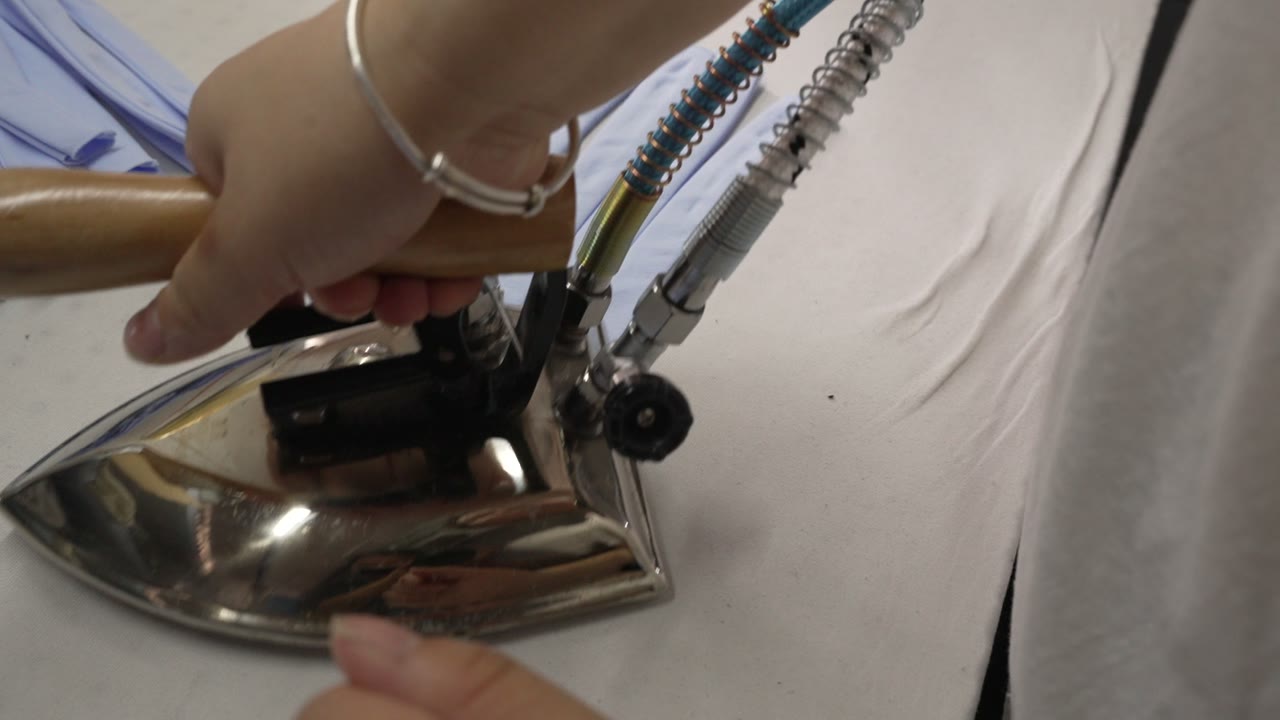
Ironing follows the same logic. GINETEX says the iron temperature should be chosen from the care label, not from the fiber content, and its one-dot symbol means a sole-plate maximum of 120 °C, the setting that corresponds to nylon. Under the FTC rule, a label mentions ironing only when it is regularly needed or when a hot iron would cause harm; “Cool iron” means the lowest setting.
Why do workout clothes still smell after washing?
Because some odor compounds survive the wash, especially in polyester. In a University of Alberta laboratory study of cotton and polyester knits, laundering removed odorants from cotton more effectively than from polyester, odorants accumulated from one to five soil-and-wash cycles, and the authors concluded that incomplete removal during washing, especially from oil-attracting polyester, is a cause of odor build-up. A care label cannot fix that alone; fiber and finish decisions, covered in the moisture-wicking fabric guide, matter as much as customer guidance.
Treat odor fixes and claims with the same discipline as the label. Vinegar, baking soda and special soaks are not standard terms in the rule; if you print one as care advice, you need a reasonable basis for it, including its effect on elastane, prints and bonded seams. If you market an odor-control finish, state what was tested and after how many washes. In the United States, EPA says pesticide-treated products that are not registered must not make public health claims such as fighting germs or providing antibacterial protection; the treated-article exemption covers only protection of the product itself.
How should stains be treated on stretch activewear?
Start with the care label and a hidden test, not a product claim. University of Kentucky extension guidance advises treating stains promptly, testing any remover on an inconspicuous part of the garment, not using chlorine bleach on fabrics containing spandex, and never ironing a stained item because heat sets stains; rinse and inspect before drying. This guide does not rank commercial removers: whatever the product, check that its directions allow the fibers and that the garment label allows its bleach type.
| Stain | Extension approach | Activewear check |
|---|---|---|
| Protein: blood, grass, mud | Soak and agitate in cold water before washing; hot water first can set the protein | Enzyme presoaks can contain bleach; confirm the label allows it |
| Oil-based: grease, oil, lotion, sunscreen | Pretreat with heavy-duty liquid detergent, then wash in hot water if safe for the fabric | “Safe for the fabric” means the label’s limit |
| Coffee and other tannin stains | Launder in detergent and hot water as safe for the fabric; old stains may need bleaching | Only the bleach type the label allows |
| Water-based paint | Rinse in warm water while wet; dried paint cannot be removed | Act before the garment dries |
| Oil-based paint | Use the thinner named on the paint label, then pretreat and launder | Spot-test; GINETEX warns against solvent removers on items labeled do not dry-clean |
| Sweat marks | Prewash stain remover or bar soap before laundering | Sweat can change some dyes; spot-test any treatment |
White garments need the same restraint. Chlorine bleach is the risk for spandex blends, while the same extension guidance describes hydrogen peroxide bleach as safe for all fibers but still requiring a colorfastness test on dyed fabrics. If you want customers to use an oxygen bleach, test it and print “Only non-chlorine bleach, when needed”; the white yoga wear guide covers shade control in production.
Decision map from this guide
| Decision area | What this guide establishes |
|---|---|
| Garment contains elastane, prints or bonded seams | Test the finished garment at the harshest setting you plan to print, then set the label from the result. |
| High dryer heat changes fit, recovery or decoration | Specify a low or no-heat setting, line drying or flat drying instead. |
| Chlorine bleach harms the product but oxygen bleach does not | Print “Only non-chlorine bleach, when needed”; “Do not use chlorine bleach” alone is not acceptable. |
| Selling in the US and in markets that use ISO symbols | Check which symbol system each market accepts and whether a GINETEX license is needed. |
| You plan an odor-control or antimicrobial claim | Limit it to what was tested; in the US, public health claims need EPA registration. |
| A fabric, print, trim or lining changes | Re-check the care evidence before reusing the old label. |
Sources and scope
The FTC’s Care Labeling Rule (16 CFR Part 423) and FTC business guidance support the U.S. label requirements; GINETEX supports the ISO symbol meanings; AATCC, an elastane producer’s technical page, a University of Kentucky extension publication, a University of Alberta laboratory study and EPA guidance support the testing, heat, stain, odor and claim points. Wording examples, tables and checklists are MOTIONFORM editorial guidance, not legal advice or a substitute for testing the finished garment. Sources reviewed 27 September 2026.
- eCFR: 16 CFR Part 423, Care Labeling of Textile Wearing Apparel, including Appendix A standard terms (reviewed 27 September 2026)
- FTC: Clothes Captioning — Complying with the Care Labeling Rule (reviewed 27 September 2026)
- GINETEX: Care symbols under ISO 3758:2023 (reviewed 27 September 2026)
- AATCC: TM150 garment dimensional change after home laundering, scope (reviewed 27 September 2026)
- The LYCRA Company: spandex degradation from chlorine, heat and UV (reviewed 27 September 2026)
- University of Kentucky Cooperative Extension: Stain Removal for Washable Fabrics, FCS2-840 (reviewed 27 September 2026)
- University of Alberta: Retention and release of odorants in cotton and polyester fabrics following multiple soil/wash procedures, Textile Research Journal 2020, accepted manuscript (reviewed 27 September 2026)
- EPA: Consumer products treated with pesticides and treated-article claims (reviewed 27 September 2026)
Buyer questions
Can sports clothes be washed at 60 °C?
Only when the care label on that garment allows it. Under the ISO system, the number in the wash-tub symbol is the maximum temperature in degrees Celsius, and a bar underneath calls for a milder cycle. A brand should print 60 only after testing the finished garment at that temperature, including its elastane, prints and trims.
How often should activewear be washed?
The care label covers method, not frequency, and no rule sets a number of wears. Washing after sweaty sessions is a sensible default, but the Alberta study shows polyester can retain odorants across repeated wash cycles, so frequency alone may not solve odor. Keep to the labeled temperature and cycle rather than washing hotter to compensate.
Should activewear go on a delicate or a normal cycle?
Use the cycle on the label. In the FTC’s standard terms, a delicate or gentle cycle means slow agitation and reduced time, and the ISO bar symbol similarly signals reduced mechanical action. A brand should call for it when testing shows that normal agitation harms the garment, for example through fuzzing, snagging or seam lift.
Is stain remover safe on spandex, nylon or polyester leggings?
It depends on the product and the garment, so test first. Apply the remover to an inside seam or hidden area, avoid chlorine-based products on spandex blends, and follow the garment’s bleach instruction. If the label carries a do-not-dry-clean symbol, GINETEX advises against stain removers that contain solvents. Rinse the remover out before washing.
How do you remove blood or grass stains from leggings?
Treat them as protein stains: soak and agitate in cold water before washing, because hot water can set the protein in the fabric. If the stain remains, an enzyme pretreatment can follow when the label permits its ingredients. Check the area before drying, since heat makes a remaining stain harder to remove.
How do you hand wash activewear?
Hand wash when the label calls for it, at the stated temperature. GINETEX’s hand-wash guidance is to dissolve a mild detergent first, move the garment gently without rubbing, pulling or wringing, rinse well, press out water carefully and reshape. A label reading only “Hand wash” permits hot water, so brands should state cold or warm where heat harms.
Does the care label have to be attached at the factory?
Not necessarily, but it must be permanent and in place before the product is sold. The FTC says importers must ensure care labels are attached before sale in the United States, though not when goods enter the country. Care instructions may also be printed on the garment, or share the fiber-content label, if they stay legible.
How should I wash another brand’s leggings?
Follow the label sewn into that item and the brand’s own care information, because they should rest on that product’s materials and construction. Generic advice cannot account for its elastic, finishes or decoration. If the label is missing or unreadable, ask the brand rather than guessing from the fiber content.
