The direct answer
A yoga wear manufacturer should translate the brand brief into controlled fit, material, construction, color, sample and quality decisions for leggings, sports bras, tops, shorts and coordinated sets, with evidence connected to the proposed factory and order.
Define the yoga use before selecting product language
Identify practice, wearer, support, coverage, climate, care and price position. A hot-yoga short, studio legging and low-impact bra create different fit, material and testing priorities.
Three buyers searching for a yoga wear manufacturer need different first answers
Intent 01 · factory search
I need a yoga clothing manufacturer
The product is still broad, so the buyer must first match categories and high-risk processes to a legal entity and physical facility. The most useful first proof is not a catalogue count but a relevant current sample and declared production route.
Next move · Select one legging, bra or set and request the exact factory and process map.Intent 02 · quotation
I know the product and need price
The buyer has a brief or tech pack but may not have closed material, color, size, logo, packaging or test assumptions. Any price before those decisions is provisional and difficult to compare.
Next move · Create one quotation basis and require suppliers to mark assumptions, exclusions and validity.Intent 03 · reference development
I have a sample or branded reference
The buyer wants the silhouette or wearer experience but must avoid copying protected logos, artwork, product descriptions and trade dress. The physical sample also hides yarn, finish, pattern and settings.
Next move · Translate permitted functions into an original specification and ownership route.Decision table: choose a yoga-wear development route
| Production route | Best fit | Buyer must control | Boundary to verify |
|---|---|---|---|
| Catalog private label | A validated existing legging, bra, top or set is acceptable with defined branding. | Current style, fabric, color, size, logo, labels, packaging and availability. | Base-product changes, shared use, factory continuity and current MOQ. |
| Adapted yoga style | A supplier base needs a new rise, strap, pocket, length, fabric or color. | Change matrix, revised sample, measurements, BOM, affected tests and ownership. | Which change creates a new pattern, material minimum, tooling or production route. |
| Custom cut and sew | The brand needs an original silhouette and controlled fit or support architecture. | Brief, pattern, grading, stretch direction, seams, samples, production release and IP. | Facility capability, subcontracted processes and representative-size validation. |
| Seamless yoga product | Engineered knit zones or tubular construction are central to the product. | Yarn, program, machine and gauge, size strategy, body map, dyeing and finishing. | Actual knitting site, remaining cut-and-sew operations and program ownership. |
Approve leggings by color, size and movement
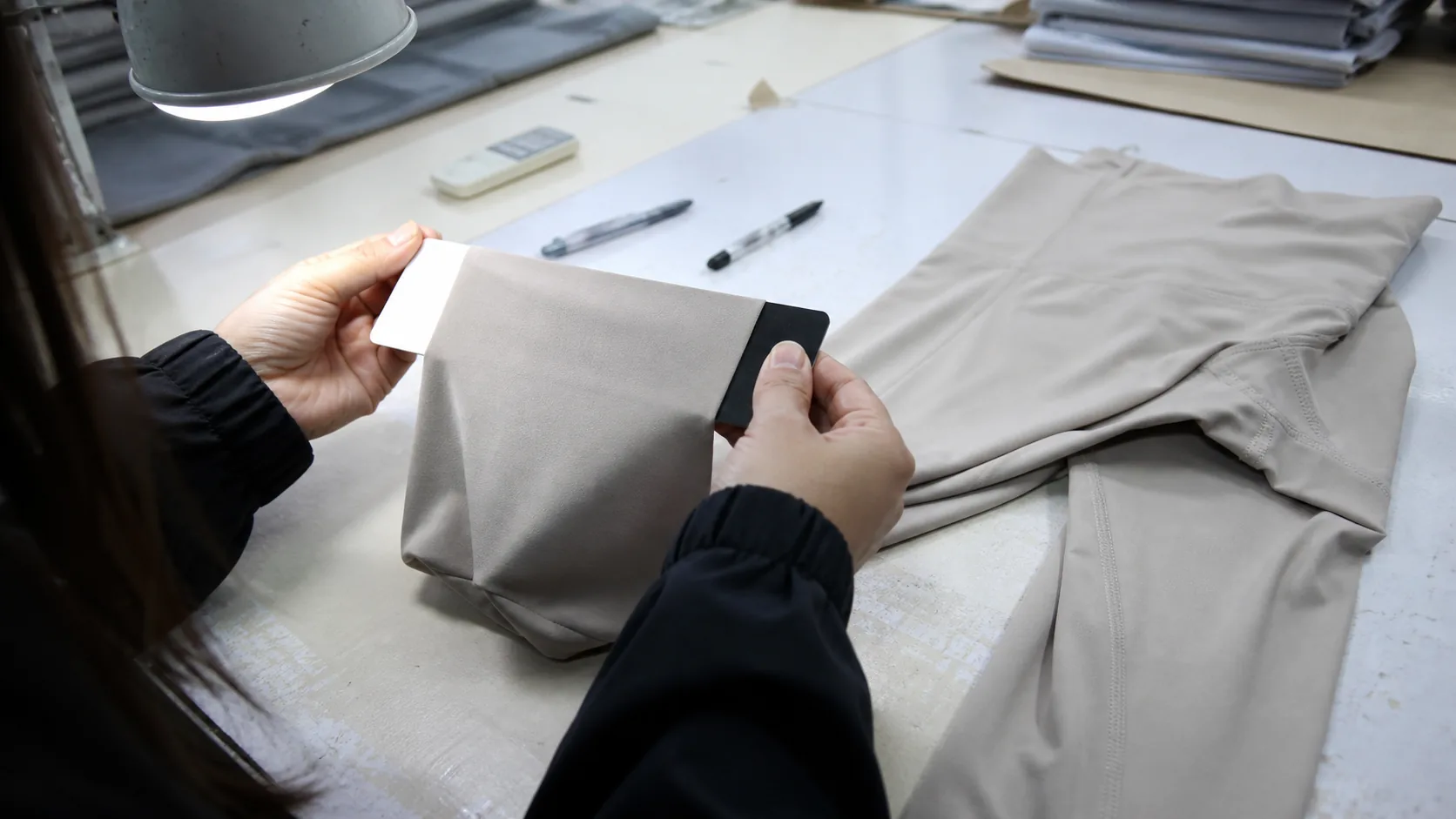
Control rise, waistband shape, crotch and gusset route, inseam, pocket, seam placement and compression direction. Review opacity and recovery in the intended shades and representative sizes under a written movement protocol.
Treat “squat-proof” as a controlled opacity question
State the garment, exact shade, material lot, size, wearer or fixture condition, lighting, stretch or movement, underlayer condition and observer or image method. A dark middle-size sample at rest cannot establish opacity across pale colors, the size range and production lots.
Review the finished garment together with rise, crotch extension, gusset, seam position and strain. If opacity fails, the decision may involve material, pattern or size architecture rather than simply increasing GSM. Record the protocol and approved sample so production inspection knows what the buyer actually accepted.
Connect bra architecture to the support brief
Define intended impact, wearer, neckline, armhole, straps, back, underband, lining and cup system. Decide which dimensions create coverage and which zones create pressure or stability. The garment must be evaluated as a system; cup material or fabric stretch alone does not prove support.
A short fitting cannot replace a wear review that records pressure, movement, moisture, adjustment, chafing and post-wear condition. Sample sizes should reflect the risks in bust and underband relationships, not only the brand’s middle size. Keep removable and fixed cup routes separate because they change care, migration, modesty and production control.
Approve a yoga set by relationship, not by one color name
Decide whether top and bottom share material, finish and dye lot or only meet a visual standard. Compare pieces together under defined light, at rest and stretch. Body fabric, lining, elastic, mesh and logo components can display the same color reference differently.
Review set proportion and split-sizing logic: waistband-to-top overlap, torso exposure, strap and neckline balance, packaging and whether customers can buy different top and bottom sizes. Release each component BOM and sample under one set-level record so a change to one piece cannot silently break the relationship.
Verify the proposed yoga wear factory at project level
Connect the legal contracting entity to the physical site that will sample and manufacture the product. List cutting, sewing, seamless knitting, bonding, printing, embroidery, dyeing and finishing, then identify what is in-house and what is subcontracted. Match every certificate or report to holder, site, scope and validity.
Use a current sample or production record relevant to the hard part of the brief. A yoga set manufacturer that shows many simple leggings may still need separate evidence for bonded hems, complex bras or engineered seamless programs. If the facility changes between development and bulk, reopen the affected evidence and approvals.
Carry every approval into production
Release the identified sample with current pattern and grading, measurements and tolerances, BOM, fabric and color references, construction, artwork, labels, packaging and quality instruction. Record remaining exceptions and who can close them; do not let chat approval replace the packet.
For bulk and reorder, recheck changes in fabric lot, finish, shade, pattern, construction, artwork component, subcontractor or supplier. The linked opacity protocol, low-impact-bra brief and pre-production checklist give the detailed decision routes. Together they turn “custom yoga wear manufacturer” from a keyword into an inspectable operating method.
Use the relevant development route
Continue with a buyer decision guide
Continue through the manufacturing topic network
Buyer questions
What products can a yoga wear manufacturer produce?
Common products include leggings, flare pants, shorts, sports bras, tanks, long sleeves, jackets and matching sets. Verify the proposed factory and process for each style.
What does custom yoga wear include?
It can include original or adapted pattern, fit, material, color, construction, logo, labels and packaging. State exactly what is custom and who owns the specification.
How do I verify a yoga wear factory?
Connect legal entity, physical site, applicable processes, certificates or reports, proposed style, quality responsibility and production-release records.
What is a normal MOQ for private label yoga clothing?
There is no universal number. Base style, fabric and color minimums, size split, branding, packaging and factory planning determine the current project MOQ.
Can a yoga manufacturer copy a Lululemon or Alo product?
No. Do not request replicas, logos, artwork or protected trade dress. Convert the intended use into an original fit, material, construction and brand specification.
More buyer questions
Should I choose a yoga wear manufacturer in China, the USA or Bali?
Choose the facility that can prove your hardest process, then weigh location. Country affects working hours, sample shipping, duties, transit time and how easily you can visit, but it does not establish capability. Send candidates in every location the same brief and evidence request, and record the legal entity and physical site so an office address is not mistaken for the factory.
How do I judge a yoga wear factory’s capacity?
Judge capacity for your product and process, not a factory-wide headline. Ask which lines or machines suit your fabric and seams, what is already booked in your delivery window and which operations leave the site. A large total can hide a bottleneck in cutting stretch fabric, bonding or printing. Get the plan for your quantity and dates in writing.
What does OEM mean for yoga clothing?
OEM usually means the supplier produces to your design and specification, while ODM usually means the supplier contributes a design that you adapt. Usage varies between suppliers, so write down who owns the pattern, who approves changes and who may reuse the design. For yoga wear, that decides whether a revised rise or waistband belongs to your brand or returns to a supplier catalog.
What is a knitted yoga wear manufacturer?
Usually a supplier working with knitted stretch fabric, the common base for leggings, bras and fitted tops, but the phrase covers two routes. One cuts and sews knitted fabric; the other knits the garment shape on seamless machines. Ask which route is proposed, because patterns, sizing, minimums and sample changes are handled differently in each.
Read the Spanish guide to choosing a yoga clothing manufacturer.
Read the Spanish guide to leggings pattern and manufacturing decisions.
