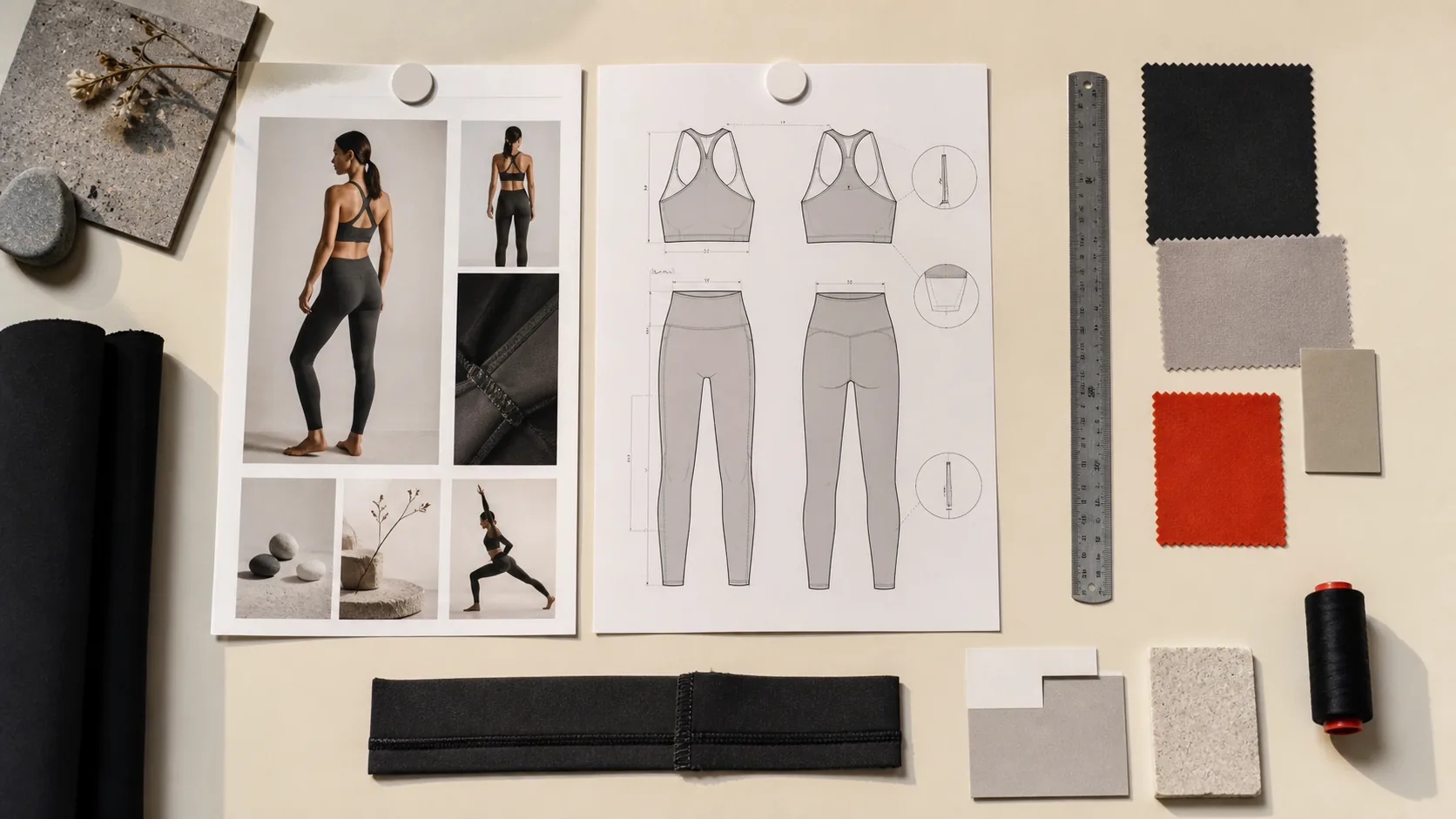
The short answer
A product brief is enough to start discovery when silhouette, target wearer, activity, price position or fabric direction is still open. A tech pack becomes necessary when the factory must quote, pattern, sample or reproduce a defined style. Before bulk, every approved decision should live in one version-controlled specification, regardless of how the project began.
Start with context and open questions, not invented certainty.
Move approved decisions from messages into the current specification.
Do not approve bulk from a mood board or reference photo alone.
What a useful product brief should establish
A brief explains the commercial and functional job of the product. Name the intended wearer, movement context, target market, size range, price position and the visual elements that cannot change. Add reference garments only to communicate a function such as coverage, hand feel or waistband height—not as permission to copy another brand.
Mark unknowns as open decisions. “Factory to propose two fabric directions” is actionable; a blank fabric field can be mistaken for approval to choose anything.
When the project needs a tech pack
A factory needs controlled information before it can make repeatable output. The pack should connect style identity, technical drawings, points of measure, bill of materials, construction, colors, artwork, labels, packaging, test requirements and revision history. Each file should carry the same style code and current revision.
The pack can mature during development. What matters is that the version used for sampling and the version released for production are identifiable and consistent.
Build a controlled handoff
Consolidate comments after each sample round. Record what changed, what is approved and which questions remain. Do not leave a critical correction only in a chat thread. Before production, compare the current pack with the approved sample, material references and purchase order.
- One owner issues consolidated comments.
- Superseded versions are archived, not silently overwritten.
- Every approval names the style, sample stage and date.
A simple decision rule
If the team is still choosing the product direction, use a brief. If someone must cut, sew, cost or inspect the product, use a controlled specification. A first conversation can begin with less; a production release cannot.
Product brief and tech pack: different jobs
| Decision dimension | Product brief | Controlled tech pack |
|---|---|---|
| Best used when | Product direction or key inputs are still open. | A defined style must be quoted, patterned, sampled or reproduced. |
| Primary job | Frame the wearer, movement context, market, size range, price position and non-negotiable visual intent. | Control style identity, drawings, measurements, BOM, construction, colors, artwork, labels, packaging, tests and revisions. |
| Treatment of unknowns | Label them as open decisions and assign the next proposal or choice. | Resolve them before the relevant approval and keep the current revision identifiable. |
| Production limit | Can start discovery but cannot release bulk by itself. | Forms part of the production baseline when reconciled with approved samples and material references. |
Decision map from this guide
| Decision area | What this guide establishes |
|---|---|
| What a useful product brief should establish | A brief explains the commercial and functional job of the product. |
| When the project needs a tech pack | A factory needs controlled information before it can make repeatable output. |
| Build a controlled handoff | Consolidate comments after each sample round. |
| A simple decision rule | If the team is still choosing the product direction, use a brief. |
Sources and scope
This guide translates primary standards and public technical sources into a buyer-side development workflow. It does not replace legal advice, a purchased standard, laboratory instructions or project-specific engineering.
Buyer questions
Can a factory start from a reference sample?
Yes. The reference can communicate fit or construction intent, but the project still needs original design decisions and a controlled specification before production.
Does a tech pack need to be complete before the first call?
No. Open items can be developed, but they should be labeled clearly and resolved before the relevant approval stage.
Read the Spanish guide to developing a sports T-shirt.
Read the Spanish guide to OEM and ODM sportswear responsibilities.
Read the Spanish guide to requesting and approving garment samples.
