The direct answer
A private-label activewear program should state whether the product is existing, adapted or custom; who owns the design and specification; which branding and packaging are included; and which samples and records authorize production.
Name the private-label product route
Existing style with defined logo, label and packaging options.
Selected changes to an existing product with new approvals.
Buyer-led or jointly developed specification and sample route.
Written design rights, territory, term and allowed reuse.
Private-label search intent splits into launch, differentiation and ownership
Intent 01 · launch
I want my logo on activewear quickly
The buyer needs a current base product, limited branding, compliant labels and an honest view of availability. The main risk is treating a visual mock-up as product, logo and packaging approval.
Next move · Choose a stable style and approve the actual branded production-intent garment.Intent 02 · differentiate
I need a supplier style changed for my market
The buyer wants a new fabric, rise, pocket, strap, color or size range. This is development even if the catalogue silhouette remains recognizable.
Next move · Write the change list, ownership and affected approval route before quotation.Intent 03 · own
I need original private brand fitness apparel
The buyer wants a controlled original product and may require pattern, grading, artwork or material rights. “Private label” alone says nothing about those rights.
Next move · Use a custom development agreement and identify every owned or licensed input.Decision table: how much control does each private-label route provide?
| Production route | Best fit | Buyer must control | Boundary to verify |
|---|---|---|---|
| White-label or stock product | A standard product can serve several brands and speed is the priority. | Product authenticity, resale rights, logo or packaging scope and current availability. | Little differentiation, uncertain repeat stock and no implied exclusivity. |
| Ready-to-brand base | A stable supplier style fits the market with approved brand components. | Base revision, material, colors, sizes, logo method, labels, packaging and sample. | Allowed artwork zones, factory route and whether the same base is sold elsewhere. |
| Adapted private label | Selected product changes create meaningful differentiation. | Change matrix, revised measurements and BOM, sample stages, IP and new tests. | Which changes trigger new MOQ, pattern, tooling, material or facility. |
| Custom or exclusive program | The brand needs original architecture and written commercial rights. | Brief, specification, ownership, territory or term, production evidence and release. | Supplier background IP, allowed reuse, tooling custody and post-relationship access. |
Build the brand identity into the BOM
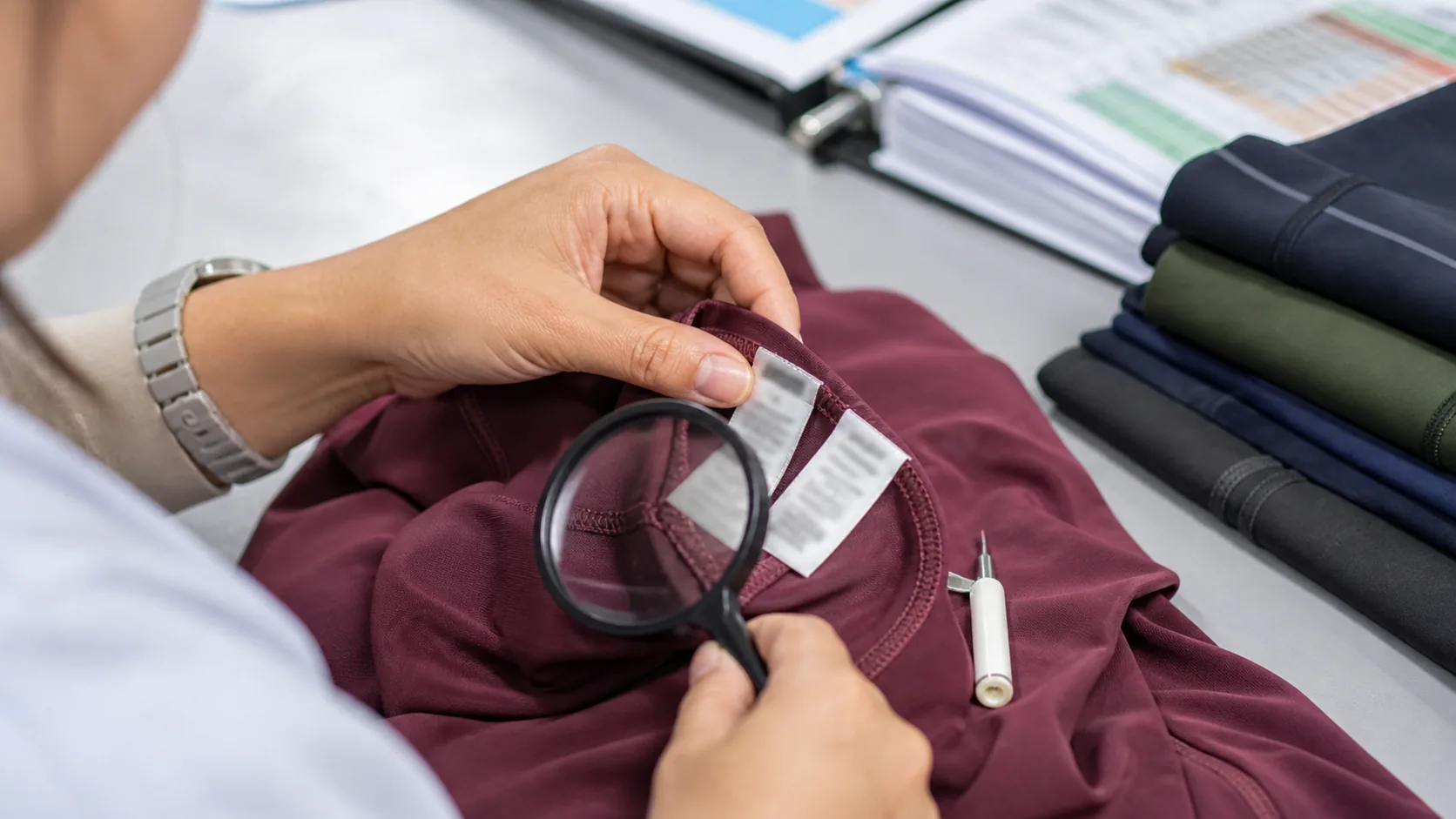
Control main and care labels, size marks, logo components, hangtags, packaging, barcodes and required market information by stable artwork and component reference. A logo file alone is not a private-label specification.
Treat every brand component as product data
The BOM should identify main label, care label, size mark, logo application, hangtag, packaging, barcode or SKU label and any market-specific content. Store approved artwork revision, dimensions, color reference, material, supplier or method, placement and sample status. A digital mock-up is a communication aid, not production evidence.
Check the finished garment for logo stretch, pressure, lifting, cracking, show-through or seam interaction. Review labels for comfort, durability and the information required in the target market. Packaging must align with product identity, size, color and set or split-size logic. If the brand component changes, the release packet changes.
Resolve design and material ownership before sampling
Record who brought the initial concept, pattern, block, grading, artwork, mold, custom color, fabric development, software file and physical sample. State which outputs are buyer-owned, supplier-owned, licensed, non-exclusive or restricted by territory or time. “Exclusive” is incomplete without scope and permitted reuse.
Also decide who can access editable files and tooling, who pays for maintenance or replacement and what happens when the relationship ends. Do not ask the manufacturer to copy protected third-party products. A lawful development path can study a functional problem and create an original silhouette, construction, material and brand expression.
Verify the manufacturer behind the private-label offer
A private label sportswear supplier may own a facility, coordinate partner sites or buy finished goods. Any route can be legitimate when it is declared. Identify the legal contracting entity, payment recipient, sample owner, proposed bulk factory and subcontracted processes such as printing, embroidery, bonding, dyeing or packaging.
Match evidence to the claim: business registration for entity identity, site-specific reports for the facility, material or article certificates for their stated scope, and a current sample for the proposed product route. Do not convert an unrelated certificate, historic customer name or catalogue quantity into a production-capability claim.
Keep private label inside the production baseline
Branding, packaging and compliance content should be approved with the garment, not added after product release. Reconcile sample identity, measurements, BOM, color standards, artwork, labels, packaging and inspection rules in one current packet. Note open points and the person authorized to close them.
Inspection should compare units with the same artwork, label and packing rules as well as garment workmanship. On reorder, review substitutions in fabric, finish, shade, component, pattern, factory or subcontractor. A private-label relationship becomes scalable when the brand can tell exactly what changed and which approval is required.
A practical private-label launch sequence
- Choose the product route and write the intended market, wearer and collection role.
- Confirm legal supplier, factory route, product identity and available customization.
- Close ownership and allowed-use terms before investing in development.
- Approve the garment, branding, labels and packaging as connected components.
- Release one production packet and define inspection and change control.
- Retain the approved evidence for reorder and future supplier comparison.
Use the linked label checklist for U.S. launch questions, the bill-of-materials guide for component control and the pre-production checklist for final release. This avoids reducing a private label activewear manufacturer search to logo placement and a unit price.
Use the relevant development route
Continue with a buyer decision guide
Continue through the manufacturing topic network
Buyer questions
What is private-label activewear?
Activewear sold under the buyer’s brand. The product can be existing, adapted or custom, so the development and ownership route must be defined separately.
What is the difference between private label and white label?
White label commonly describes a standard product offered to several brands, while private label can include broader customization or exclusivity. Actual contract terms matter more than the label.
What branding elements can be included?
Logo applications, main labels, care and size labels, hangtags, packaging, barcodes and other retail components can be included when specified and approved.
Does private label mean the design is exclusive?
No. Exclusivity must be written by product, input, territory, customer, term and permitted reuse. A private label can use a standard base sold to several brands.
What MOQ does a private-label activewear manufacturer require?
It varies by base product or custom route, material and color minimums, size split, branding, packaging and factory planning. Use a current product-specific quotation.
More buyer questions
How do OEM, ODM, white label and private label fit together?
They answer two different questions. Private label and white label describe whose brand goes on the product and how exclusive the base is; OEM and ODM describe who supplies the design and specification. One program can therefore be ODM and private label at once—a supplier-developed legging sold only under your brand—while a white-label piece is typically a supplier style also offered to other brands.
How do you white label or private label clothing that already exists?
Start with a product you have the right to resell, agree in writing what the supplier will change, then replace or add labels without losing required information. For U.S. sales, FTC guidance says a substitute label must carry the required information from the one removed, and a business that substitutes labels must keep records of the original label and supplier for three years. Approve the branded sample before bulk.
What are white-label clothing companies?
They are suppliers that sell existing garments for other businesses to brand: blank-apparel wholesalers, catalog manufacturers with ready-to-brand bases and print-on-demand services are typical types. Because the product exists before your brand, check who else sells it, whether fabric or colors can change between orders and which labels and packaging you may replace. For men’s and women’s ranges, review each base’s size chart and fit separately.
Is private label the same as your own brand?
To the shopper, yes: the product carries your brand. The difference is who makes it, because a private-label or own-label product is manufactured by another company for the brand owner; retailers also use the terms for store brands. Owning the brand name does not automatically give you the design, pattern or material rights, which come from the development agreement.
Should a private-label manufacturer be in the USA, Europe, Australia or China?
Choose the product route first and the country second. A nearby maker can simplify visits, communication and shipping, while a distant one may offer different materials, capacity or costs; every option needs the same checks on entity, facility, samples, labels and change control. For U.S. sales, the label must disclose the country of origin, whatever brand appears on it.
Additional sources
Read the Spanish guide to white-label and private-brand activewear.
