The short answer
For most U.S. textile apparel, plan labels that accurately state fiber content, country of origin and the identity of the manufacturer or responsible business, plus care instructions that have a reasonable basis. Review the exact product, components, sales channel and current rules with qualified compliance support before launch.
Connect fiber statements to the actual BOM and evidence.
Do not copy care instructions across unverified materials.
Approve label artwork, placement and durability as production components.
Map the required information
The FTC explains that most textile and wool products require fiber content, country of origin and the identity of the manufacturer or another responsible business. Determine how the responsible identity will be shown and verify special cases for the product.
Create care instructions with a reasonable basis
The Care Labeling Rule requires regular care instructions and a reasonable basis for them. Review body fabric, lining, cups, elastic, logo and other components under the proposed care route, then include warnings when a commonly assumed procedure would cause harm.
Control artwork and placement
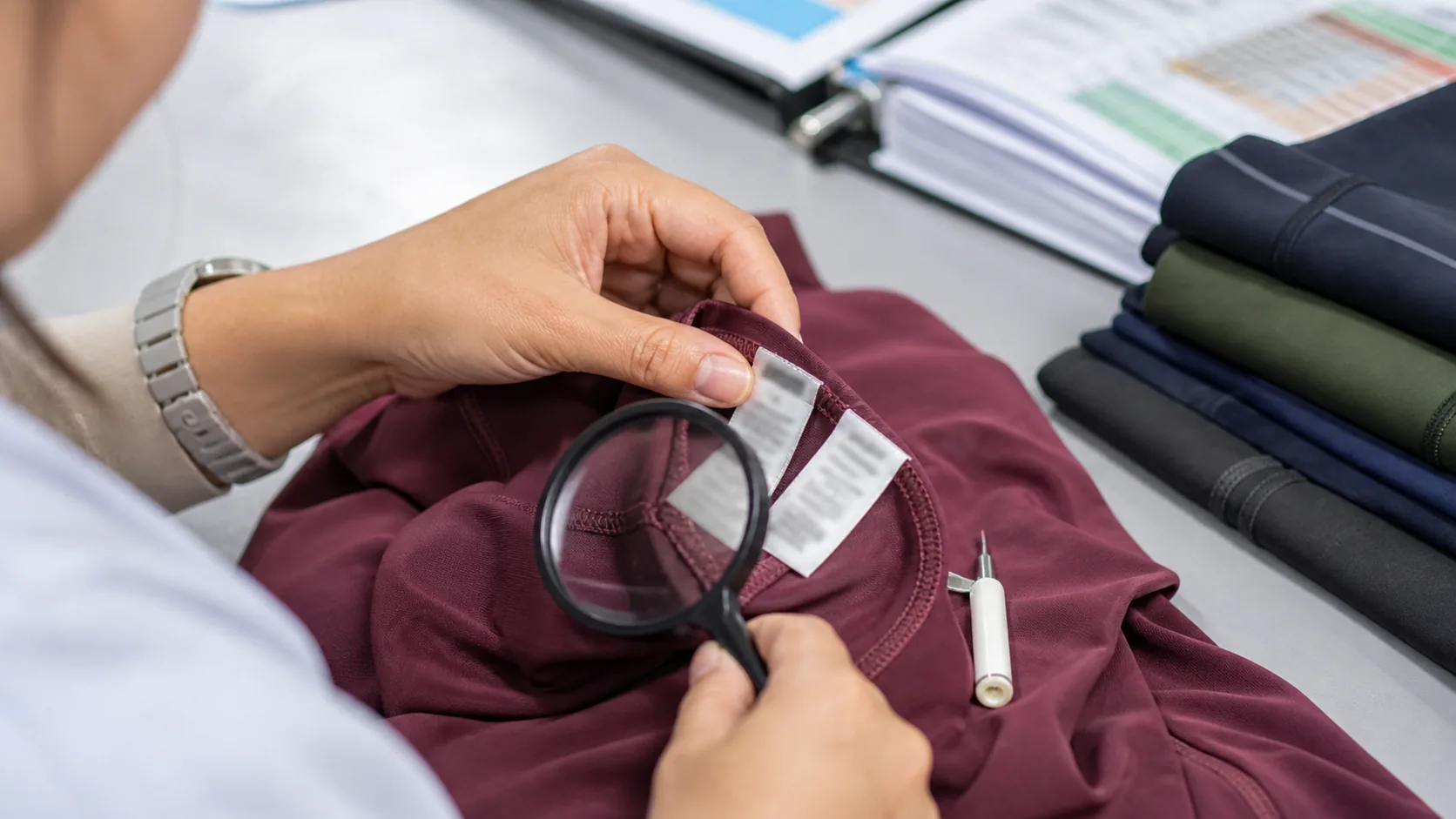
Store approved wording, language, font, symbols, dimensions and placement in the specification. Check legibility, attachment and comfort on the garment. A correct text file is not enough if production uses the wrong label version.
Keep market rules separate
Do not assume one label automatically satisfies every destination. Create a market matrix and obtain current legal review where needed. This article is a development checklist, not legal advice.
Decision map from this guide
| Decision area | What this guide establishes |
|---|---|
| Map the required information | The FTC explains that most textile and wool products require fiber content, country of origin and the identity of the manufacturer or another responsible business. |
| Create care instructions with a reasonable basis | The Care Labeling Rule requires regular care instructions and a reasonable basis for them. |
| Control artwork and placement | Store approved wording, language, font, symbols, dimensions and placement in the specification. |
| Keep market rules separate | Do not assume one label automatically satisfies every destination. |
Sources and scope
This guide translates primary standards and public technical sources into a buyer-side development workflow. It does not replace legal advice, a purchased standard, laboratory instructions or project-specific engineering.
Buyer questions
Can care symbols replace words in the U.S.?
FTC guidance explains the permitted ASTM symbol route and conditions. Confirm the current rule and artwork before use.
Does the factory decide the fiber declaration?
The supplier can provide material evidence, while the responsible business must ensure the public label is accurate for the finished product.
More buyer questions
What does the RN number on a clothing tag mean?
It is a Registered Identification Number that the U.S. Federal Trade Commission issues to a U.S. business that makes, imports, sells or otherwise handles textile products, and it can replace the company name on the label. RNs are not issued to businesses outside the United States, so on an imported garment the RN usually identifies the importer, wholesaler or consenting retailer.
Where must the required labels go on a garment sold in the U.S.?
On a garment with a neck, FTC guidance puts the country of origin on the front of a label at the inside center of the neck; for bottoms, it gives the inside of the waistband as an accessible spot. Fiber content and the responsible company may sit on the same or another conspicuous label, and care instructions need a permanent label.
Are care labels required by law in the UK and the EU?
In the EU, the textile rules require a fiber-composition label but not care instructions: the European Commission’s FAQ on Regulation (EU) No 1007/2011 says care and size labeling are not covered by that Regulation. The UK now sets its own rules, so confirm the current position with Trading Standards before dropping care instructions; shoppers still rely on them to avoid damaging the garment.
What do the symbols on a care label mean?
They are shorthand for the harshest treatment the garment can take. GINETEX, which licenses the symbols, explains the families: a wash tub for washing, with the number giving the maximum temperature and bars a milder cycle; a triangle for bleaching; a square for drying; an iron with dots for heat; and a circle for professional cleaning. A cross forbids the treatment. For U.S. labels, check the ASTM route noted above.
Is there a standard care label for polyester, cotton or a T-shirt?
No. Care instructions belong to the finished garment, not the fiber name on its label. A polyester legging with a printed logo, bonded seam or mesh lining can need tighter limits than a plain polyester T-shirt, and cotton pieces vary with dye and finish. GINETEX notes that ironing temperature should follow the care label rather than fiber content, so test the complete style first.
What are care labels made of, and how large should they be?
Pick the material and size for the garment’s contact zone and the text the label must carry. Woven, printed fabric and heat-transfer labels differ in comfort and wash durability. The European Commission says the EU sets no harmonized size or font for fiber labels, while FTC guidance says required information must be clearly legible, conspicuous and readily accessible. Wash-test the label on the garment before approval.
Additional sources
- FTC: Threading Your Way Through the Labeling Requirements Under the Textile and Wool Acts (reviewed 27 September 2026)
- GINETEX: Existing care symbols under ISO 3758:2023 (reviewed 27 September 2026)
- European Commission: FAQs on Regulation (EU) No 1007/2011 on textile fibre names and labelling (reviewed 27 September 2026)
