The short answer
Measure yoga fabric or garments before and after an agreed washing and drying procedure, using defined marks and conditioning. Review length and width change plus spirality, seam twist or panel distortion. Apply the result to the actual pattern and care instruction rather than quoting an isolated percentage.
Name the exact wash and drying procedure.
Measure both dimensions and visible twist.
Confirm the care label has a reasonable evidence basis.
Define the conditioning and care procedure
ISO 5077 specifies dimensional-change measurement used with an appropriate washing and drying procedure. Record specimen condition, wash cycle, temperature, detergent, load, drying route and number of cycles agreed for the program.
Use a repeatable measurement map
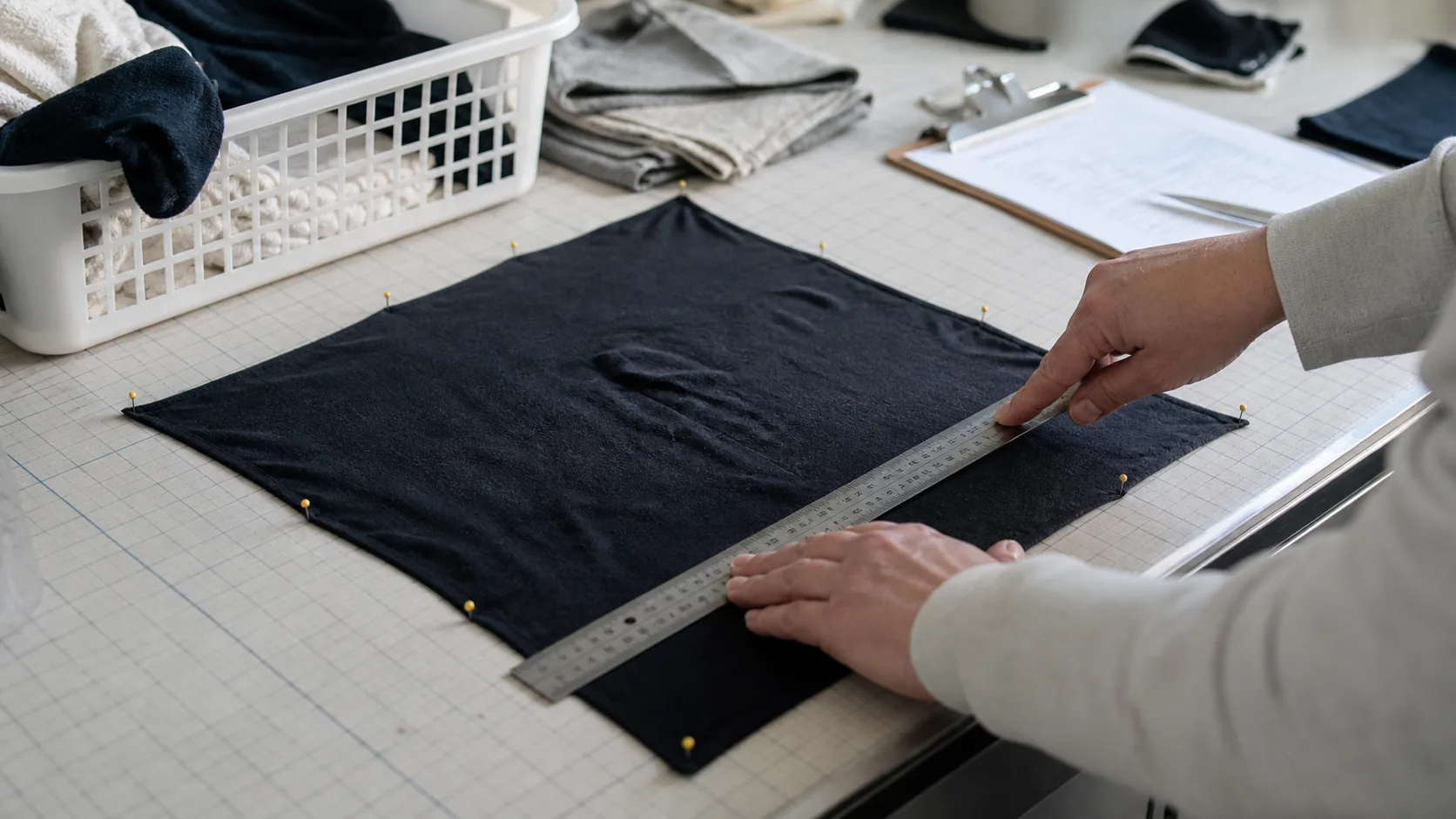
Mark length and width positions on fabric or stable points on the garment. For leggings, include inseam, outseam, rise and leg opening as relevant. Measure after the defined relaxation or conditioning period.
Record more than percentage change
Spirality and torque can rotate seams or distort panels even when average length change looks acceptable. Photograph seam position and hem balance before and after care.
Connect evidence to pattern and label
The product team can account for predictable change through material selection, finishing or pattern allowance, but the approved garment still needs to meet the intended fit. U.S. care instructions require a reasonable basis, so the tested condition should support the instruction used.
Decision map from this guide
| Decision area | What this guide establishes |
|---|---|
| Define the conditioning and care procedure | ISO 5077 specifies dimensional-change measurement used with an appropriate washing and drying procedure. |
| Use a repeatable measurement map | Mark length and width positions on fabric or stable points on the garment. |
| Record more than percentage change | Spirality and torque can rotate seams or distort panels even when average length change looks acceptable. |
| Connect evidence to pattern and label | The product team can account for predictable change through material selection, finishing or pattern allowance, but the approved garment still needs to meet the intended fit. |
Sources and scope
This guide translates primary standards and public technical sources into a buyer-side development workflow. It does not replace legal advice, a purchased standard, laboratory instructions or project-specific engineering.
Buyer questions
Is fabric shrinkage the same as garment shrinkage?
No. Seams, elastic, panels and construction can change the finished-garment result.
Can the care label be copied from another style?
Only when there is a reasonable basis that it applies to the actual materials and construction.
Can drying or dry-cleaning instructions be chosen from the fibre label?
No. The care decision concerns the finished item: body fabric, rib, elastic, cups, lining, transfers, thread and closures may not respond alike. First read the instruction for the actual style. If a method is not listed, do not treat the absence as proof that it will work. For development, resolve the uncertainty before approving the label.
The FTC guidance concerns the United States and requires a reasonable basis for care information. It also distinguishes washing from dry-cleaning instructions. This is not a universal worldwide label template. Have the responsible importer or adviser review the requirements in each destination market.
| Buyer question | Evidence to request | Decision to avoid |
|---|---|---|
| Tumble drying | Finished sample, approved drying procedure and post-care measurements | A universal temperature inferred from the fibre name |
| Dry cleaning | Support for the proposed process and all attached components | Assuming a washable T-shirt is safe in every solvent |
| Will it shrink? | Before/after dimensions, procedure and acceptance limits | Treating “preshrunk” as zero dimensional change |
| A changed logo or trim | Review of the changed component in the garment | Reusing an old care label without checking the change |
A practical review record can include sample identity, starting dimensions, the selected procedure, resulting dimensions and observations of twist, surface or decoration. If the result fails the project requirement, revise material, construction or the proposed care route and check again. Do not hide the mismatch by quietly widening an agreed tolerance.
More buyer questions
Can leggings go in the dryer?
Use the drying instruction for the actual leggings; there is no safe universal setting for the whole category. For a new style, ask for evidence covering the finished construction, including waistband, decoration and other components. Compare dimensions and appearance after the agreed care procedure. A fabric swatch or a similar product’s label is not enough to approve every finished garment.
Can T-shirts be dry cleaned?
Only rely on dry cleaning when the care information and supporting evidence allow it for that particular shirt. A washable label does not establish compatibility with every professional cleaning process. In product development, review prints, adhesives, trims and the body together. Ask a qualified cleaner or technical adviser about an unsupported method rather than recommending it from fibre composition alone.
Which T-shirts do not shrink?
A category name or fibre claim cannot establish zero shrinkage. Ask for results on the identified shirt under the intended washing and drying procedure, including measurement positions and acceptance limits. Compare body length, width, neckline and seam balance. For purchasing, a documented dimensional-change result is more useful than a general “preshrunk” description without its method or scope.
Can workout clothes or gym shorts shrink in the dryer?
Yes, they can, and the amount depends on the fibers, the knit or weave, earlier heat setting and the dryer’s heat. Gym shorts can shrink unevenly because a woven shell, knit liner and elastic waistband respond differently, which shows up as puckering rather than a smaller size. Measure the finished garment before and after the drying method your label allows.
Does knitted fabric shrink more than woven fabric?
Not always, but knits often show relaxation shrinkage because their loops are held under tension during knitting and finishing and can relax in washing. Wovens can shrink too, particularly those made from cellulosic fibers. Whether either fabric was compacted or heat-set before cutting matters more than the structure name, so measure length and width change on the actual fabric and garment.
Can activewear be shrunk on purpose to fit better?
It is not a reliable fix. Deliberate high-heat washing or drying shrinks unevenly, can damage spandex, prints and bonded seams, and takes the garment outside its tested care instruction. If customers keep wanting a smaller fit, review the pattern, size chart or grading instead. For a product in development, set the fit through measurements and approved samples, not post-purchase shrinking.
