The short answer
Nylon-based yoga fabrics are often selected for a soft, smooth or cool hand, while polyester directions can support dry-hand, color and performance priorities. Neither fiber guarantees quality. Compare actual fabrics for the intended garment, color, finish, stretch recovery, pilling, opacity and care condition.
Write performance priorities before asking for composition.
Approve the actual fabric in the actual color.
Do not infer durability or sustainability from fiber name alone.
Begin with product context
Describe activity, climate, support, surface preference, expected care and price position. A soft studio legging, hot-yoga short and training bra place different demands on hand feel, moisture handling, recovery and abrasion.
Compare the whole fabric
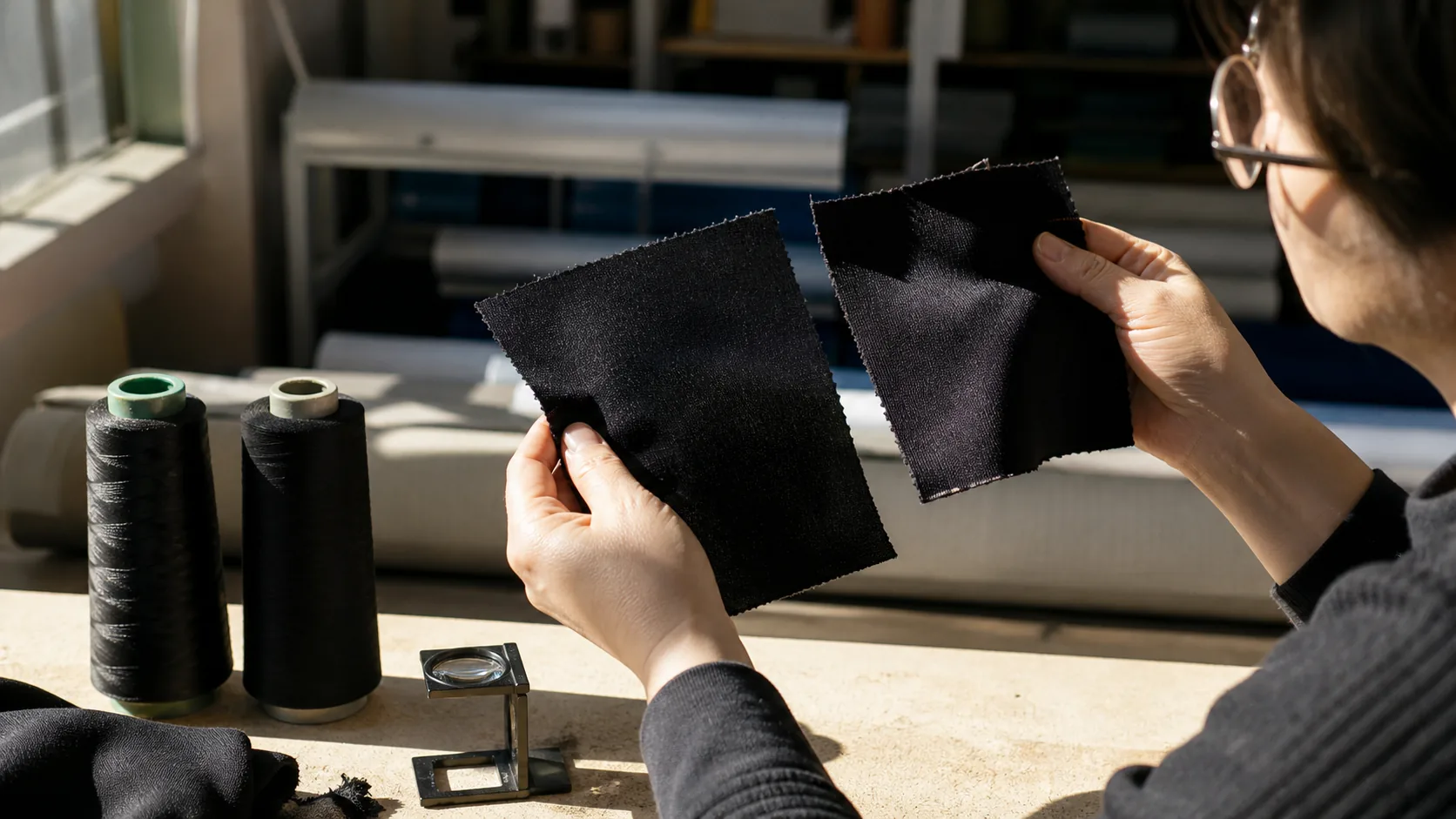
Ask for fiber content, yarn type where relevant, knit construction, weight, stretch direction, finish and color process. Evaluate swatches side by side, then review the selected direction in a garment because pattern strain changes feel and opacity.
A nylon-based candidate usually enters the shortlist because the brief asks for a soft, smooth or cool hand; a polyester-based candidate usually enters because a dry hand, a color requirement or another defined performance priority leads. That difference in starting reason changes what to check first: where the soft hand comes from a brushed finish, screen surface pilling before anything else; where saturated shades are the reason, screen rubbing and perspiration fastness first. In both cases approve the represented fabric and garment result, not the fiber name.
Screen the risks connected to the finish
Brushing can improve softness and matte appearance while increasing surface-pilling risk. Deep shades can create rubbing or perspiration-fastness concerns. High stretch can expose color and coverage differences. Match the test plan to the fabric and product risk.
Approve by reference and evidence
Retain the approved swatch or material reference, record the test scope and define how a replacement will be reviewed. A bulk fabric described as the same composition and GSM is not automatically equivalent.
Nylon-based and polyester-based fabric directions
| Decision dimension | Nylon-based direction | Polyester-based direction |
|---|---|---|
| Why it enters the shortlist | A soft, smooth or cool hand is part of the product direction. | A dry hand, a color requirement or another defined performance priority leads the search. |
| What to ask the mill first | Where the softness comes from: yarn type, knit and finish, and how the hand holds after the proposed care. | Where the color or performance claim comes from: the color process, the moisture behavior in the garment and the test basis behind the claim. |
| First risk to screen | If the soft hand comes from a brushed finish, screen surface pilling before anything else. | If deep or saturated shades are the reason, screen rubbing and perspiration fastness before anything else. |
| What the fiber name does not settle | Softness. A nylon label does not guarantee a softer hand than a polyester alternative; yarn, knit and finishing decide it. | Comfort in heat. A polyester label does not decide drying, opacity or durability; the full fabric brief and garment test do. |
Decision map from this guide
| Decision area | What this guide establishes |
|---|---|
| Begin with product context | Describe activity, climate, support, surface preference, expected care and price position. |
| Compare the whole fabric | Ask for fiber content, yarn type where relevant, knit construction, weight, stretch direction, finish and color process. |
| Screen the risks connected to the finish | Brushing can improve softness and matte appearance while increasing surface-pilling risk. |
| Approve by reference and evidence | Retain the approved swatch or material reference, record the test scope and define how a replacement will be reviewed. |
Sources and scope
This guide translates primary standards and public technical sources into a buyer-side development workflow. It does not replace legal advice, a purchased standard, laboratory instructions or project-specific engineering.
Buyer questions
Is nylon always softer than polyester?
Not always. Fiber contributes, but yarn, knit and finishing can change the final hand substantially.
Which is better for hot yoga?
Choose from the full fabric performance brief and garment test; fiber name alone cannot decide comfort, drying, opacity or durability.
Nylon, polyester, spandex or elastane: what do the names mean?
These names do not sit on one scale. Nylon and polyester are base fibers, spandex is the stretch fiber blended with either of them, and LYCRA® is a brand of spandex fiber. “Nylon vs spandex” or “polyester vs Lycra” therefore compares a base fiber with a stretch fiber; the useful comparison is usually a nylon-spandex fabric against a polyester-spandex fabric, judged as complete materials.
US textile rules supply the definitions. Under 16 CFR 303.7, nylon is a manufactured fiber whose fiber-forming substance is a long-chain synthetic polyamide, and spandex is a long-chain synthetic polymer made of at least 85 percent segmented polyurethane. The same section also recognizes the generic names in ISO 2076. A label reading polyamide therefore names the chemical family that includes nylon, and The LYCRA Company’s own pages refer to spandex (elastane) fabrics.
Treat LYCRA® as a trademark, not a generic word. The LYCRA Company states that LYCRA® is a globally registered trademark it owns and that using its word marks or logos requires a trademark license agreement. A fabric can contain spandex without containing LYCRA® fiber. If you want the name on a hangtag or product page, confirm the fiber source with the mill and the licensing terms with the trademark owner first.
| Label reads | What it tells you | What it leaves open |
|---|---|---|
| Nylon/spandex or polyamide/elastane | A polyamide base fiber with a stretch fiber | Yarn fineness, knit, finish, recovery and pilling |
| Polyester/spandex | A polyester base fiber with a stretch fiber | Hand, drying in the garment, odor and color behavior |
| Polyester/rayon/spandex | Polyester, rayon (regenerated cellulose under the same rules) for softness and drape, plus stretch | Shrinkage, pilling and slower drying than an all-synthetic knit |
| Polyester or nylon only | A base fiber with no stretch fiber | Whether any stretch comes from the knit or is absent |
Percentages show proportions, not performance. Two nylon-spandex fabrics can feel and recover differently because of yarn, knit and finishing; the composition and GSM guide explains how to compare them. Polyester-spandex is not waterproof either: a knit lets water through its structure, water repellency needs a finish, and waterproofing needs a membrane or coating.
Which dries faster, feels warmer or smells less: nylon or polyester?
No fiber-only rule answers these questions reliably. Drying speed, warmth and breathability depend more on yarn, knit density, weight, surface finish and fit than on whether the base fiber is nylon or polyester: a brushed polyester fleece will usually feel warmer than a thin nylon jersey, and a different pairing can reverse the result. Compare shortlisted fabrics with the same test on the same basis; the moisture-wicking and breathability guide lists what to request.
Odor has published evidence, but it is narrower than many online answers suggest. In a Ghent University study published in 2014, T-shirts collected from 26 people after an intensive spinning session were incubated for 28 hours. A trained panel found the polyester shirts smelled significantly less pleasant and more intense than the cotton shirts, and micrococci were detected almost solely on the synthetic shirts. The study compared polyester with cotton only, so it cannot rank nylon against polyester or describe every finish and knit.
For a brand, odor stays a wear-test observation until a claim is supported. Record wear time, activity, care history and odor notes when comparing fabrics, and keep any finish-based wording within its tested scope, as the fabric guide explains for odor-control finishes. For hiking pants, running shorts or tights, compare the woven or knit candidates for abrasion, snagging and drying in the actual construction instead of choosing by fiber name.
More buyer questions
Are leggings the same thing as spandex?
No. Leggings describe a garment category, while spandex describes a manufactured fibre that may form part of its fabric. Read the actual composition rather than treating the two names as interchangeable. For sourcing, also identify knit construction, finish and garment design; the presence of a stretch fibre alone does not establish opacity, recovery, durability or fit.
Does nylon-spandex lose its stretch over time?
It can, and polyester-spandex can too. Repeated extension, heat in drying or processing, and chemicals such as chlorine can reduce the stretch fiber’s recovery, while the knit itself can relax and grow. Ask for stretch and growth results after the wash and dry cycles your care label will specify, and review high-strain zones such as the seat and waistband on a worn sample.
Is nylon-spandex good for underwear and shapewear?
It is widely used for both, but each product needs its own targets. An underwear brief should define hand, gusset lining, edge finishing and care. Shapewear needs a defined level of hold, measured as fabric tension at an agreed stretch and then confirmed on the body. Compare polyester-spandex alternatives on the same criteria instead of treating nylon as the automatic choice.
Is LYCRA® fiber better than other spandex?
Not automatically. LYCRA® fiber is one company’s branded spandex, offered in several named variants, and whether it improves your fabric shows up in the fabric’s stretch, recovery and durability results rather than in the name. If you pay for a branded fiber, ask the mill for documentation that it is present, and follow the trademark owner’s rules before naming it on product labels.
Additional sources
- FTC: textile fibre and fabric definitions
- GovInfo: 16 CFR 303.7, generic names and definitions for manufactured fibers (reviewed 27 September 2026)
- The LYCRA Company: trademarks and patents (reviewed 27 September 2026)
- Callewaert et al., Applied and Environmental Microbiology (2014): odor of polyester and cotton shirts after exercise (reviewed 27 September 2026)
Read the Spanish guide to activewear fibers: elastane, polyester and nylon.
