The short answer
Activewear and swimwear can resemble each other, but appearance does not establish interchangeable use. Start with the intended activity and the exact product. For a crossover design, review the complete garment in the proposed conditions and obtain evidence appropriate to each claim before describing it as suitable for swimming.
A colourfastness result is not a whole-garment swimming approval.
Outer fabric, lining, elastic and closures need connected decisions.
Keep pool-water and sea-water questions distinct.
Can athletic wear be used as swimwear?
Only assess a particular item, not the whole category. A training top may have been developed around exercise on land, while a swim top has a different intended environment. Before using or marketing a garment for swimming, check the manufacturer's stated purpose and restrictions. A pool or venue can also impose its own clothing requirements; confirm those independently.
For a brand developing a crossover product, write both uses into the brief. Name pool or sea exposure, movement, coverage and care, then ask what evidence is needed for the complete construction. Do not ask a supplier to relabel an unreviewed gym garment as swimwear merely because the fabric contains a familiar fibre.
Can a sports bra, yoga pant or tennis skirt cross over?
A sports bra brings questions about band, straps, cups and lining. Identify which components are present and whether they are represented by the proposed assessment. A result for the outer textile does not automatically cover padding, elastic, bonding or a closure. The sports-bra wear-review guide helps organize fit observations, but a land-based review does not validate swimming use.
Yoga pants require attention to coverage, waistband position, openings and any pockets when wet. A tennis skirt adds another layer relationship: outer skirt, inner short, waistband and storage. Review the actual construction rather than assuming that one part being close-fitting settles the whole garment. Record unsupported uses as unsupported; resemblance to a swim legging or swim skirt is not evidence.
What changes between gym shorts and swim trunks?
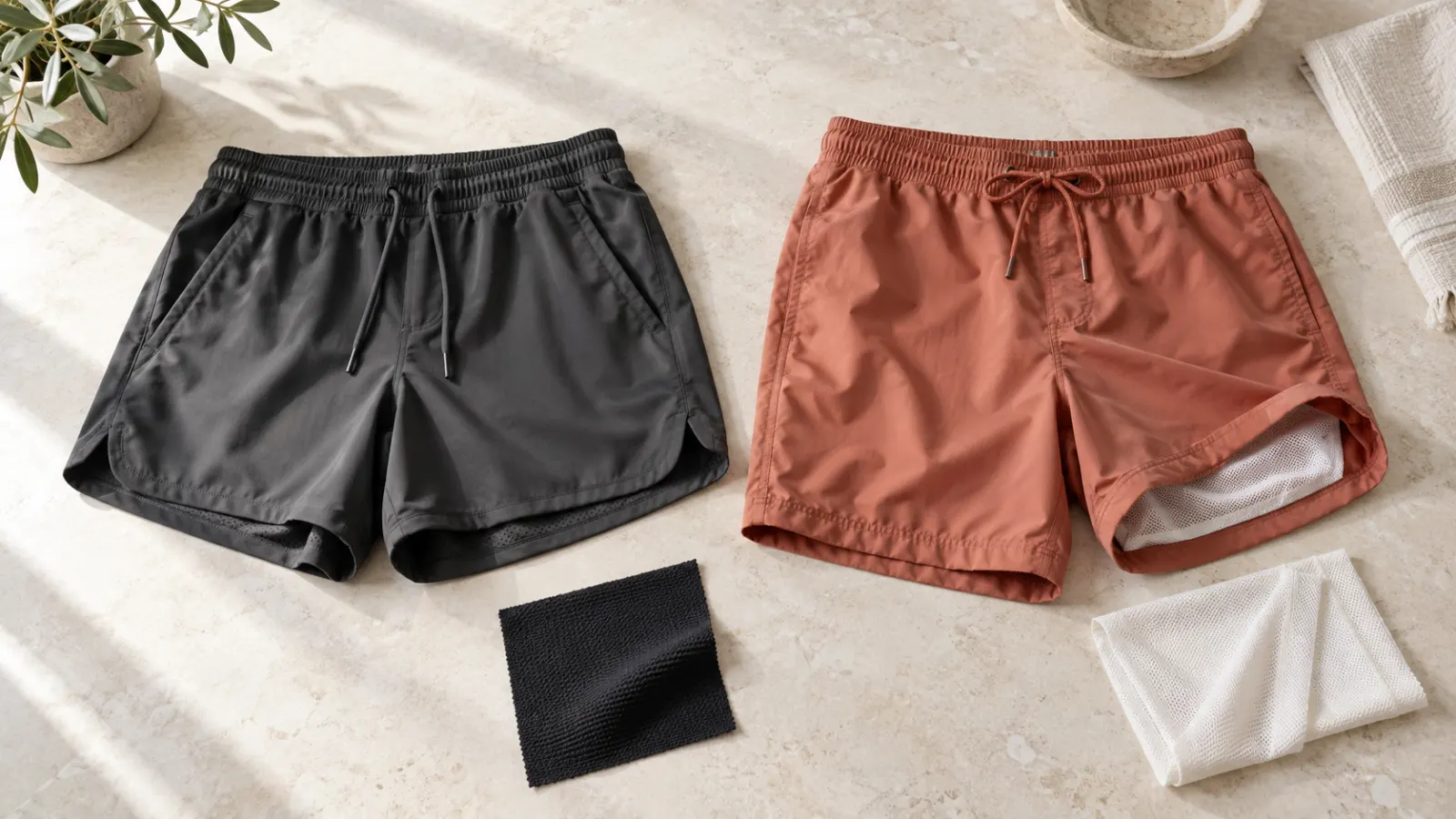
Start with the component drawing. Identify shell, liner, waistband, drawcord or closure and every pocket. Ask the developer to explain how each component supports the intended use and which questions remain. A product called “shorts” can hide a very different construction from the sample the buyer expects.
For a crossover range, keep the original running-shorts brief alongside a separate swimming-use review. A dry-running pocket check does not answer its behaviour in water. Likewise, a lining selected for land-based comfort is not automatically approved for another exposure. Changes should be recorded in the specification, not left as verbal reassurance.
What can chlorine and sea-water tests establish?
ISO 105-E03:2010 addresses colour resistance to chlorinated swimming-pool water. ISO 105-E02:2013 addresses colour resistance to sea water. Their published scopes answer particular colourfastness questions, not every question about a swim garment. The laboratory should select the relevant current method and conditions for the project.
Keep colour change separate from fit, strength, recovery, coverage and component integrity. Ask what specimen a report represents and what it leaves untested. A favourable result should be stated within that scope. It does not establish an unlimited service life, swimming safety, universal chlorine resistance or suitability for every water environment.
Maintain a simple evidence register: claim wording, represented component, specimen identity, method, condition, result and unresolved limit. If a material or finish changes, ask which evidence remains applicable. For general textile comparisons, the fibre-versus-fabric guide explains why composition alone is not a finished-product specification.
How should a buyer organize a crossover sample review?
First separate document review from physical evaluation. Confirm the intended uses and components, then have an appropriately qualified specialist define the assessment. Do not improvise a safety-critical swimming trial from a marketing brief. Identify the sample, size, materials, method and acceptance decisions before the work starts.
After evaluation, record each outcome separately. If the shell meets the colour requirement but a trim remains unresolved, the garment is not fully approved. Preserve the result and the open decision instead of summarizing the whole sample as “passed.” Compare revisions against the same recorded requirements so that an improved appearance cannot hide a change in another attribute.
For production, connect the reviewed garment to the pattern revision, material references, lining, elastic, trims and care information. The production-release checklist provides a handover structure; it is not a substitute for the additional evidence a swimming claim may require.
How do you wash swimwear or a crossover garment?
Follow the care instructions for the actual item. Do not infer a washing, drying or cleaning method from the word swimwear, or copy a land-based activewear label to a new construction. When developing the product, ensure the intended care is considered alongside the components and claimed use.
The FTC guidance concerns substantiation of care instructions for the United States. It is not a global label template or a universal household washing recipe. For your selling market, have the responsible party confirm the requirements and keep the evidence with the released version. A changed decoration or lining may require another review.
Activewear and swimwear: compare the requirement
| Decision dimension | Land-based activewear brief | Swimming or crossover brief |
|---|---|---|
| Use condition | Identify the intended exercise and environment. | Specify the water environment and every intended use. |
| Layers and components | Review the selected construction for the stated movement. | Check whether shell, lining, elastic, padding and trims are covered by the swimming assessment. |
| Colour evidence | Choose methods relevant to the land-based exposure. | Distinguish pool-water and sea-water colour questions; neither is a complete garment approval. |
| Fit and coverage | Record movement, strain and garment position. | Define appropriate wet-condition assessment with qualified review. |
| Care and release | Use evidence tied to the actual finished item. | Reconcile the additional use with the components and care instructions. |
Decision map from this guide
| Decision area | What this guide establishes |
|---|---|
| Can athletic wear be used as swimwear? | Only assess a particular item, not the whole category. |
| Can a sports bra, yoga pant or tennis skirt cross over? | A sports bra brings questions about band, straps, cups and lining. |
| What changes between gym shorts and swim trunks? | Start with the component drawing. |
| What can chlorine and sea-water tests establish? | ISO 105-E03:2010 addresses colour resistance to chlorinated swimming-pool water. |
| How should a buyer organize a crossover sample review? | First separate document review from physical evaluation. |
| How do you wash swimwear or a crossover garment? | Follow the care instructions for the actual item. |
| How to use MOTIONFORM’s development guidance | This guide helps turn a category question into a documented buying decision. |
How to use MOTIONFORM’s development guidance
This guide helps turn a category question into a documented buying decision. It does not establish a swimwear production capability, certification or test result for MOTIONFORM. Use the linked specification and approval resources to identify open questions, then seek project-specific technical review and written confirmation of scope before committing to production.
Buyer questions
Can athletic wear be used as swimwear?
Do not assume so from appearance or fibre content. Check the actual product’s intended use and any restrictions, then review the complete garment for the proposed swimming conditions. For a brand, obtain evidence appropriate to the claim rather than changing the label alone. Also confirm the clothing requirements of the pool or venue where the product is intended to be used.
Can sports bras be used for swimming?
Only consider a particular sports bra for swimming when its intended use and supporting evaluation cover that environment. Check cups, padding, lining, band, straps and closures as well as the outer fabric. A dry exercise review or textile colour result does not establish the complete garment’s suitability. For a new design, identify these gaps before making a crossover claim.
Can yoga pants be used for swimming?
A yoga-pant label does not establish swimming suitability. Check whether the actual product is intended for water use and whether the construction has been assessed accordingly. For development, identify waistband, openings, pockets, wet coverage and material questions separately. Do not generalize from another legging with a similar shape or composition, and keep unsupported use claims out of the product description.
Can tennis skirts be used for swimming?
Do not treat a tennis skirt as a swim skirt without product-specific support for that use. Review the outer skirt, inner short, waistband and pockets as one construction under an appropriate assessment plan. Similar coverage while standing on land is not sufficient evidence. For a crossover design, define the additional requirements before selecting materials or approving the sample.
What is the difference between gym shorts and swim trunks?
The meaningful difference is the intended use and the construction that supports it, not simply the length or product name. Compare shell, liner, closures, pockets and care information, and ask what evidence covers water exposure. A gym sample approved for land-based movement is not automatically a swimming product. Specify both uses explicitly when developing a crossover style.
How should swimwear be washed?
Follow the care instructions for the actual garment instead of applying one method to every swim product. For a new style, substantiate the proposed care for the complete construction and destination market. Keep lining, elastic, trims and decoration in scope. If a component changes, review whether the earlier care evidence still represents the product before retaining the same instruction.
More buyer questions
What fabric is swimwear usually made of?
Most swimwear uses nylon or polyester knits blended with spandex; cotton is uncommon because it absorbs water, sags and dries slowly. Some fiber makers market elastane for swimwear; The LYCRA Company, for example, says LYCRA XTRA LIFE® brand swimwear resists damage from chlorine, UV rays and sunscreen. Treat such descriptions as supplier claims to verify with fabric tests for your use.
Should swimwear use nylon-spandex or polyester-spandex?
Choose from the water exposure and the product promise, not a rule. Nylon-spandex is often chosen for a soft, smooth hand, while polyester-rich swim fabrics are often proposed where frequent pool use makes chlorine and color durability the priority. Ask for chlorinated-water or sea-water colorfastness and stretch-recovery results on each candidate, and approve the complete garment, not only the fabric.
Can compression shorts be used for swimming or surfing?
Only if the specific shorts are intended and evaluated for water. Land-based compression shorts may lose coverage when wet, hold water in the waistband or liner, or use elastic and prints not chosen for chlorine or salt water. Surfing adds board contact and sun exposure, and any sun-protection claim needs its own evidence. Check the product’s stated use before recommending it.
What is the difference between a bodysuit and a swimsuit?
Both are one-piece garments, but they are built for different conditions. A bodysuit is normally worn as land clothing, often with a snap or hook closure at the crotch and fabrics chosen for dry wear; a swimsuit is built for water, with swim fabric, lining and elastics selected for wet use. Do not market one as the other without evaluating it.
How do swimwear, swimsuits and underwear differ?
Swimwear is the category, and a swimsuit is one garment within it. Underwear is designed to be worn under clothing, typically with a hygienic gusset lining and fabrics not selected for chlorine or sea water, so it should not be sold for swimming. Purpose-made swimwear matters because its fabric, lining and construction are chosen and checked for use in water.
Additional sources
Describe the activity, water exposure and open construction decisions before requesting a crossover-product review.
Sources and scope
Primary sources establish the scope of selected colourfastness methods and care guidance. The comparison and review sequence are original buyer decision tools, not a swimming-safety approval, test protocol or claim about a named supplier.
