The direct answer
A running wear manufacturer should receive a use-led brief covering distance and climate, garment layers, movement and chafe zones, sweat and drying priorities, pocket load, visibility details, fit and size range, care, decoration and the evidence required for any performance claim.
Write the run before the garment
State the expected distance range, climate, layering context, pace or movement intensity, carrying needs and care pattern. Those choices change fabric weight and structure, coverage, ventilation, seam placement, pocket architecture and reflective-detail questions. “Breathable running top” is too broad to quote or test responsibly.
Build the range around distinct jobs
| Product | Primary job | High-risk decisions | Useful approval |
|---|---|---|---|
| Running T-shirt or singlet | Move moisture and reduce contact without restricting the stride or arm swing. | Armhole, neckline, side seam, surface, wet cling and decoration. | Movement and wet-condition wear review on named sample. |
| Running short | Allow stride while controlling liner, waistband, storage and coverage. | Rise, split, liner, inner-thigh contact, pocket bounce and opening. | Loaded-pocket run sequence and representative-size fit. |
| Tight or base layer | Stay positioned under repeated movement and layers. | Negative ease, seam route, openings, opacity and heat balance. | Movement, recovery and care comparison. |
| Jacket or outer layer | Manage wind or weather priorities while remaining packable or visible. | Shell construction, closures, vents, hood, reflectivity and seam needs. | Use-condition review plus claim-specific evidence. |
Make a friction and storage map
Mark underarm, side, inner-thigh, waistband, liner, zipper, label and pack-contact zones. Place seams and trims with the intended movement and layering in mind. For pockets, define the item, mass, placement and run sequence; a phone-sized outline without bounce or access criteria does not close the design question.
Treat sweat, color and care as separate questions
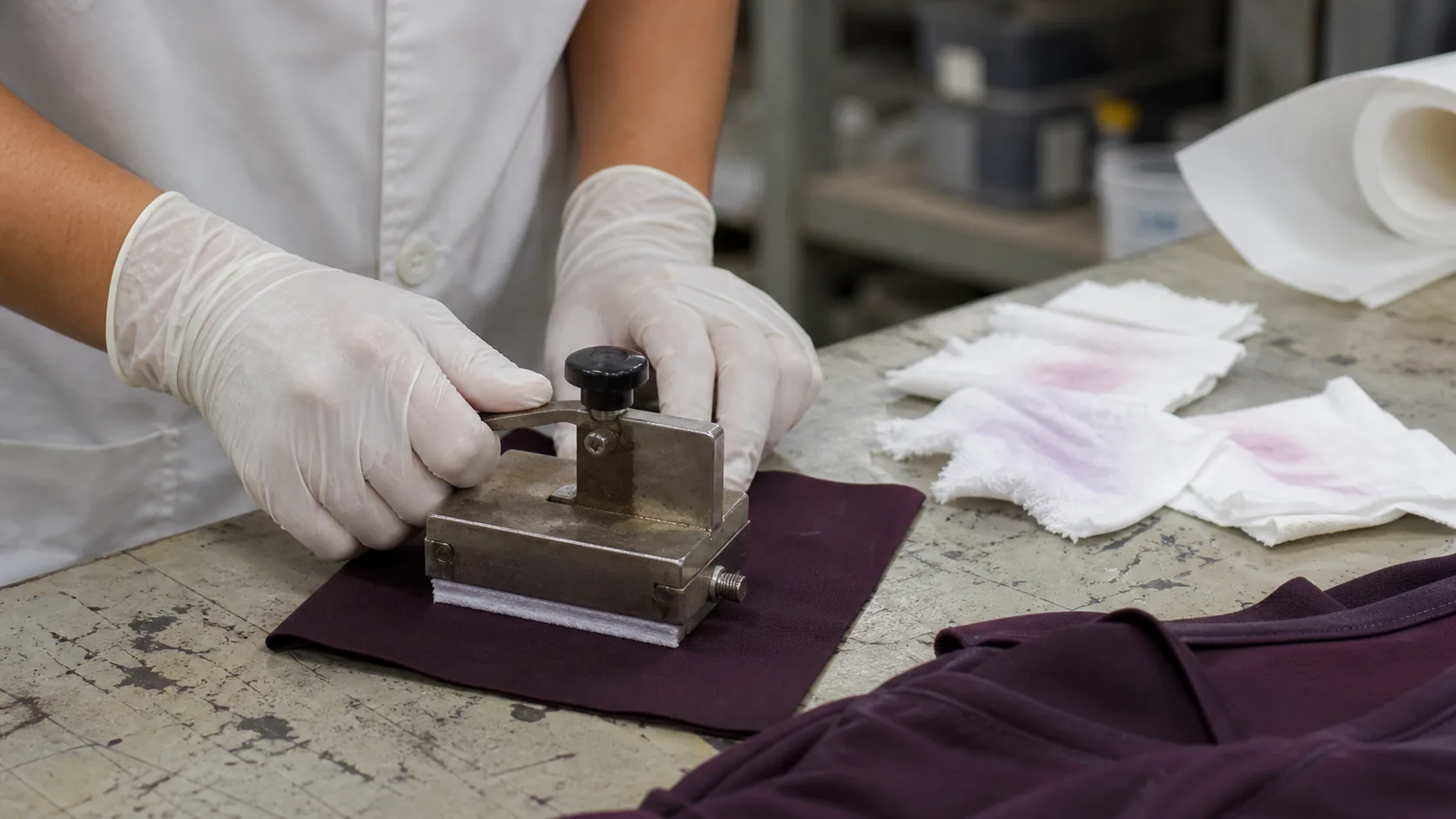
Perspiration colorfastness, domestic washing and material drying behavior require different methods and specimens. Select the applicable test with the laboratory rather than treating a general “performance fabric” report as universal proof. Deep shades, contrast panels and printed logos may need product-specific review where staining or migration would be visible.
Care instructions must be supported for the destination market. In the United States, the FTC publishes clothing and care-labelling guidance; the brand remains responsible for ensuring the finished item is correctly represented.
Use one difficult style to qualify the factory
A split short with liner and storage, or a lightweight top with contrast decoration, reveals more than a plain sample. Ask the running clothing manufacturer to explain pattern control, lightweight-fabric cutting and sewing, seam and trim route, printing or heat application, in-line checks and how a wet or distorted component is handled. Identify every off-site process.
Release by use condition and component
- 01
Fit and movement. Record sizes, wearers, run or movement sequence and unresolved observations.
- 02
Fabric and color. Identify article, lot, shade, finish and evidence tied to the intended claim.
- 03
Construction. Lock seam, stitch, thread, liner, elastic, closures and reflective or decorative components.
- 04
Storage. State pocket item, position, access and movement acceptance.
- 05
Bulk and reorder. Preserve the approved baseline and require notice before substitutions or facility changes.
Keep “moisture-wicking” and visibility language inside evidence
A performance adjective should identify the represented material or garment, method and condition. A reflective-looking trim is not automatically certified for a particular visibility use, and a fabric moisture result does not describe every garment zone. If the product is intended for a regulated high-visibility application, obtain qualified requirements and testing for that use rather than extrapolating from ordinary running apparel.
Primary sources and evidence boundary
These sources define the scope of selected test methods, certification or labelling questions. They do not certify MOTIONFORM, a supplier, a factory or a finished product. Select the applicable edition, specimen, laboratory and market requirements for the live project.
- ISO 105-E04:2013 — colour fastness to perspirationOfficial source · reviewed 2026-09-04
- ISO 6330:2021 — domestic washing and drying procedures for textile testingOfficial source · reviewed 2026-09-04
- ASTM textile standards — current abrasion, stretch and fabric test catalogueOfficial source · reviewed 2026-09-04
- U.S. Federal Trade Commission — Care Labeling Rule guidanceOfficial source · reviewed 2026-09-04
Use the relevant development route
Continue with a buyer decision guide
Continue through the manufacturing topic network
Buyer questions
What products can a running wear manufacturer develop?
Common routes include running T-shirts, singlets, shorts, tights, base layers, jackets and accessories, but capability must be checked against each product’s material, construction and use condition.
How do I test a running-shorts pocket?
Define the item and load, garment size, wearer, placement, access method and movement sequence, then record bounce, migration, discomfort and distortion.
Does a moisture-wicking fabric prove the finished shirt dries quickly?
No. Confirm the exact material result and then assess garment construction, fit, layers, climate and use condition.
Should reflective trim be treated as decoration?
Not when the brand will make a visibility or safety claim. Match the intended claim to the applicable component and product evidence.
What should be fixed before bulk running-wear production?
Approve the sample, pattern, measurements, materials, liner, elastic, seams, trims, artwork, labels, packaging, inspection points and applicable test records.
Choose shorts by movement and layer, not a category label
When a buyer asks for a short inseam, clarify whether the request concerns the outer shell or the liner. Those dimensions can solve different problems. Record the wearer, activity and intended coverage, then compare candidates through the same movement sequence. A longer shell does not necessarily change liner migration, and changing the liner need not change the visible hem.
| Observed problem | Compare first | Keep separate |
|---|---|---|
| Shorts ride up | Rise, thigh room, opening, liner and movement record | A guessed size change versus an observed pattern correction |
| Pocket bounce | Item, placement, attachment and load | Storage capacity versus behaviour during running |
| Coverage feels insufficient | Outer and inner lengths in the relevant size | Still photographs versus movement |
| A worn sample looks distorted | Original measurements, use and care history | A product-life promise versus a specific observation |
Change one relevant variable at a time where practical and record what happened. If a liner, shell and waistband are all changed between samples, a better result does not tell you which decision resolved the problem. Use the record to decide what must carry into production and what remains open.
Do not publish a fixed lifespan from a material name or one wear review. Define the condition in which the garment should remain serviceable and agree how deterioration will be evaluated. Retain the initial sample and after-care observations so that a reorder can be compared with the same reference rather than a memory of how it felt.
More buyer questions
How long should gym shorts be?
Choose length around coverage and the planned movements, then record it as a garment measurement in the sample size. Specify shell and liner lengths independently when both are present. Review bending, stride and equipment contact on representative wearers. There is no single inseam that guarantees suitability for every body, sport or market; confirm the intended use before grading the range.
Why do gym shorts ride up?
Migration needs an on-body review of the complete shorts, not an automatic recommendation to size up or tighten the hem. Record when the movement occurs and compare rise, thigh room, opening, liner and material behaviour. Check whether the shell, liner or both move. Trial a controlled adjustment and repeat the same sequence before approving a correction.
How are running shorts different from gym shorts?
The distinction should come from the intended task, not only the catalogue category. A running brief may emphasize repeated stride, liner contact and carried-item movement; a gym brief may involve other ranges of motion or equipment contact. Specify both use cases if needed and review the same sample in each. Neither name proves suitability for every exercise.
Are gym shorts always polyester?
No. Gym shorts can use different materials and components; the product name does not declare fibre content. Obtain the actual composition and identify shell, liner, elastic and panels separately. Select the material around movement, coverage, care and decoration, then review the finished sample. Do not infer drying behaviour, durability or stretch solely from a polyester label.
How long do gym shorts last?
There is no defensible universal lifespan without defined use, care and failure criteria. For a new product, agree what counts as unacceptable change in seams, waistband, surface, dimensions and decoration, then assess an identified sample under a documented plan. Keep results tied to those conditions. A supplier’s general durability claim is not a guarantee for every wearer or frequency of use.
Running shorts, half tights or tights: what is the difference?
They differ in length and fit. Running shorts are usually loose with an inner liner; half tights are close-fitting and end around mid-thigh or above the knee; tights run full length; running pants are looser full-length layers. Each changes chafe control, pocket placement, support and warmth, so build the range around the run and review each product in its own movement test.
What should a cold-weather running range include?
Plan layers rather than one heavy garment: a close base layer, an insulating mid layer where needed, a wind- or water-resistant shell with vents, tights or pants, and gloves and headwear. Add reflective or high-contrast details for low light, and test zips, cuffs and pocket access while wearing gloves. Keep any warmth or weather claim tied to a test of that garment.
What makes running clothes suitable for hot weather?
Suitability comes from the whole garment, not one fabric label. Light, quick-drying fabric, ventilated zones where heat builds up, few seams in contact areas and a fit chosen to limit cling and chafe all help. Check how the fabric looks and feels when wet, since sweat marks and transparency change the product, and back any cooling or UV claim with evidence.
What is the difference between a running shirt, a singlet and a tank?
A running shirt usually has sleeves, a singlet is a sleeveless running top with deep armholes and narrow straps, and tank is a broader retail word for sleeveless tops. The choice changes armhole depth, chafe points, room for a race number and decoration placement. Specify neckline, armhole and hem measurements rather than the name, and review arm swing on the sample.
Additional sources
Compare the extra water-use requirements in the activewear and swimwear guide.
Gym shorts, basketball shorts and golf shorts: compare the task
A gym-shorts brief may need bending and equipment contact, a basketball brief repeated strides and directional changes, and a golf brief rotation, bending and storage. These are proposed review situations, not fixed construction rules. Choose the situations that match your customer rather than treating a sport label as a performance result.
Casual shorts, long pants, leggings and sweatpants offer different lengths, ease and layering choices. Compare coverage, opening and movement using the selected samples. A fitted liner may be close to the body while the outer short remains loose. If the whole garment feels restrictive, review rise, thigh room, opening and material instead of assuming sportswear must be tight.
Further buyer answers
Are gym shorts made of spandex or supplied with padding?
Neither feature is guaranteed by the name. Spandex is a fibre that may be included in a component, and padding is a separate construction choice. Ask for the shell, liner, composition and component drawing. Do not mistake a liner for padding or assume that padded cycling construction belongs in every gym short; specify what the intended activity requires.
