The direct answer
Before selecting a compression wear manufacturer, define whether the product is close-fitting sports apparel or carries a measurable pressure or health-related claim; then align pattern and grading, elastic behavior, seam placement, wear review, applicable testing, labelling and production controls to that exact scope.
First decide what “compression” means
A close-fitting gym top, performance base layer and product making a quantified pressure or medical claim can face different engineering, evidence and regulatory questions. Do not let the category name silently create a health or performance promise. Write the intended use, wearer, garment zone and claim boundary before the factory proposes fabric or negative ease.
If the product may be presented as therapeutic, medical or performance-enhancing, obtain qualified regulatory and claims advice for the destination market. A garment factory or fabric certificate cannot decide that classification for the brand.
Map the compression system
| System area | Define before sampling | Review on garment | Record for bulk |
|---|---|---|---|
| Torso or limb fit | Coverage, length, movement and acceptable pressure direction. | Migration, restriction, local pressure and recovery after wear. | Pattern and grade revision; measurement and tolerance. |
| Fabric | Stretch axes, hand, recovery, surface and care expectation. | Growth, opacity, comfort and seam interaction. | Article, lot, shade, finish and applicable evidence. |
| Openings and bands | Width, elastic or self-fabric route and placement. | Curling, constriction, migration and marks. | Component identity, tension method and construction. |
| Seams and panels | Load direction, chafe zones and visual architecture. | Bulk, stretch, abrasion and range of motion. | Seam type, stitch, thread and machine route. |
| Claim | Exact public wording and represented condition. | Whether the chosen method can support it. | Specimen, method, result, date and approval owner. |
Negative ease is not a universal percentage
The same reduction does not create the same feel across materials, body zones or sizes. Pattern shape, anisotropic stretch, recovery, seam direction and openings all affect the result. Select fit sizes by proportion and risk, and record observations by zone and movement. A single strong wearer preference should not be converted into a universal performance conclusion.
Resolve construction at the high-friction zones
Armholes, underarms, inner thighs, waistbands and hem openings often combine stretch, seam bulk and repeated contact. Review seam type, allowance, thread, stitch density, cover, bonding or taping against the actual fabric and use. Flat-looking is not automatically low-chafe, and a named seam is not proof without the specified construction.
Match the record to the statement
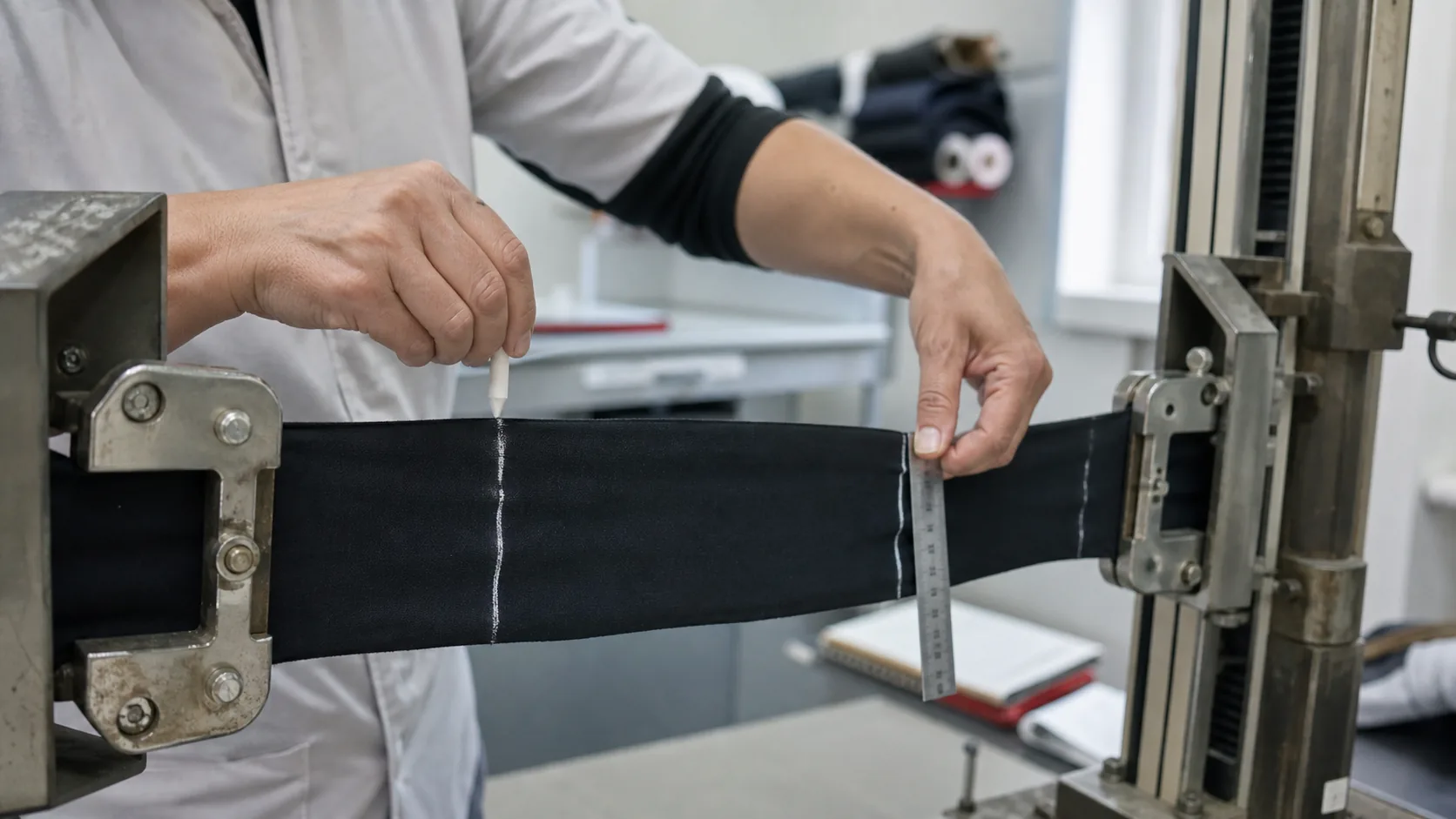
ISO 20932-1 describes strip-test methods for fabric elasticity and related properties; it does not by itself establish finished-garment pressure, comfort or athletic benefit. Washing, perspiration colorfastness and abrasion standards address other defined questions. Choose methods with a qualified laboratory and keep the test specimen connected to the product claim.
Marketing copy should identify what was measured or observed and avoid expanding a fabric result to every finished style.
Five gates for a compression apparel factory
- 01
Claim gate. Factory and buyer agree which statements are product direction and which require independent evidence or review.
- 02
Pattern gate. Negative ease, grade rules and high-risk body zones are identified.
- 03
Material gate. The exact article, lot, direction and finish are controlled.
- 04
Wear gate. Named sizes and movement conditions are reviewed with structured observations.
- 05
Release gate. The approved garment, data, construction and claim scope are reconciled before bulk.
Verify the physical and specialist production route
Ask where pattern, cutting, sewing, bonding, printing and testing will occur. Compression garments can require ordinary cut-and-sew processes or specialist equipment depending on the design; the seller should identify the actual proposed route instead of relying on a category label. If the factory changes after approval, assess the transfer and resampling need.
Primary sources and evidence boundary
These sources define the scope of selected test methods, certification or labelling questions. They do not certify MOTIONFORM, a supplier, a factory or a finished product. Select the applicable edition, specimen, laboratory and market requirements for the live project.
- ISO 20932-1:2018 — determination of fabric elasticity by strip testsOfficial source · reviewed 2026-09-04
- ISO 6330:2021 — domestic washing and drying procedures for textile testingOfficial source · reviewed 2026-09-04
- ISO 105-E04:2013 — colour fastness to perspirationOfficial source · reviewed 2026-09-04
- ASTM textile standards — current abrasion, stretch and fabric test catalogueOfficial source · reviewed 2026-09-04
Use the relevant development route
Continue with a buyer decision guide
Continue through the manufacturing topic network
Buyer questions
What should I ask a compression shirt manufacturer?
Ask how it will interpret the intended use, pattern negative ease, stretch directions, panels, openings, seams, movement fit, material evidence and claim boundary for the exact shirt.
Can a fabric stretch test prove compression performance?
No. It can characterize defined fabric properties under the method; finished-garment pressure or benefit requires its own suitable evidence and claim review.
Is a compression clothing manufacturer a medical-device manufacturer?
Not necessarily. Product classification depends on intended use, claims and the applicable market rules. Seek qualified advice before making health or therapeutic claims.
How should compression shorts be sampled?
Include sizes and body proportions that expose waistband, thigh opening, rise, opacity, seam and movement risks, then record the exact material and garment revision.
Can I use “performance compression” in marketing?
Only when the wording is truthful, appropriately substantiated and within the represented test or review scope for the target market.
Graduated medical compression or athletic compression: what differs?
The difference is intended use and evidence, not how tight the garment feels. Athletic compression describes a close-fitting garment patterned smaller than the body so the fabric holds it in place. Medical compression describes products designed to apply controlled pressure for a medical purpose, which places them in a regulated category.
In the United States, 21 CFR 880.5780 classifies a medical support stocking as a device constructed of elastic material and designed to apply controlled pressure to the leg. A stocking intended to prevent the pooling of blood in the legs is Class II; one intended for other medical purposes is Class I. Describing sports leggings in those terms moves the product toward that regime, so settle the intended use with qualified regulatory advice before any sample is briefed as medical.
“Graduated” describes an intended pressure profile that changes along the limb, which has to be designed into the garment and verified by measurement. A sports legging is not graduated because its fabric feels firm or its ankle is narrow. Unless the garment is engineered and verified to such a profile and the regulatory route is settled, keep the word out of the brief and the product copy.
Claims follow the same line. The Federal Trade Commission’s health-products guidance says health-related claims need competent and reliable scientific evidence, and that animal or in vitro studies without confirmation in human randomized controlled trials are not sufficient. A fabric report or a fit session describes the garment; it does not substantiate a claim about the body.
| Term | What it describes | Evidence that fits | Wording boundary |
|---|---|---|---|
| Athletic compression | Negative ease for a firm, held fit | Fit and wear review; fabric tension at an agreed elongation | Feel, fit and measured values within the tested scope |
| Graduated medical compression | A controlled pressure profile for a medical purpose | The medical-device requirements of the target market | Medical wording only through that regulated route |
| Shapewear | Firm panels that smooth the silhouette under clothing | Fit and appearance review; fabric tension | Appearance benefits, not health benefits |
How do compression fit, muscle fit and shapewear differ in a brief?
They describe different jobs. A muscle-fit top is cut close to follow the body with little or no squeeze. A compression fit is patterned smaller than the body so the fabric holds it. Shapewear uses firm, often zoned panels to smooth or reshape the silhouette under other clothing. Write the job first, then specify the fabric and fit that deliver it, because none of these names fixes a level.
“High compression” and “most compression” have no shared scale between brands. To compare candidates, measure fabric tension at the same elongation: ASTM D4964 covers the tension and elongation of elastic fabrics and requires the parties to agree the loop tensions and elongations at which results are reported, as well as any laundering cycles. Use those results to rank fabrics, then confirm how the garment behaves on bodies in the target sizes. The same logic answers whether compression shapewear differs from regular shapewear: compare measured hold, not the label.
Bike shorts can be cut as compression garments or as easier-fitting shorts, so the name does not settle it; the shorts guide compares the main types. Leggings sold with built-in resistance bands add a different claim: ask what the bands are said to do and what evidence supports any exercise benefit before repeating it.
Very firm garments can be hard to put on, and the waistband and leg seams take that strain. Include putting the garment on in the fit review, check seams and elastic afterwards, and add guidance to the hangtag if wearers need it. For gym compression shirts, state the intended feel, sleeve and neckline, underarm seam placement and fabric tension, and publish a size chart that says whether the fit is meant to feel firm.
More buyer questions
Can compression leggings help with cellulite, lipedema or circulation?
That is a medical question for a clinician, and this page cannot answer it. For a brand, claims like these are health-related claims: they need the evidence standard and, where a garment is intended to apply controlled pressure for a medical purpose, the device route described above. Keep them off sports leggings whose support rests only on fit, feel or fabric tests.
What do compression shorts actually do?
By design, they hold the garment close to the body, limit fabric movement, provide coverage under other layers and give a firm feel. Those are fit and construction outcomes you can review in sampling. Claims that they improve performance, reduce soreness or speed recovery are separate claims that need evidence for the specific product before they appear in marketing.
Are compression leggings supposed to feel tight?
They are meant to feel firmer than regular leggings, but the fit brief should define how firm. In fit sessions, record where pressure concentrates, whether the waistband digs in or rolls, and whether the wearer can move through the intended activity without restriction. Publish sizing guidance that describes the intended feel, so customers do not size down in search of more compression.
What are compression shirts made of?
Usually a knit of nylon or polyester combined with a substantial share of spandex, sometimes with mesh panels for ventilation. The fiber label gives proportions but not the knit, finish or recovery, which decide how firmly the shirt holds. Compare candidate fabrics by tension at an agreed elongation and recovery after washing, then review the finished shirt at the underarm, neckline and hem.
Can compression garments be bad for you?
Individual health questions, such as bruising, wear during flights, pregnancy or a medical condition, belong with a clinician rather than a garment specification. A brand’s job is narrower: size the garment accurately, review pressure and marks in fit sessions, describe the intended fit honestly and avoid safety or health promises. A product intended for medical use follows the regulated route described above.
