The short answer
A yoga wear evidence request should identify the exact claim being checked, the evidence holder and facility, applicable product or material, scope, validity period and connection to the current order. Separate factory-audit, material, product-test, development and inspection records.
A certificate logo is not a scope review.
Keep facility, mill, dye house and product evidence separate.
Record gaps and due dates instead of converting missing evidence into assumptions.
Start with the exact claim
Write the sentence the business wants to rely on, then ask which evidence would support it. “Certified factory” is too vague. Name the scheme, holder, facility, scope, date and whether the current product or order is represented.
Separate facility and supply-chain roles
The garment factory, fabric mill, dye house, printer and trim supplier can hold different records. A material certificate held upstream should not be presented as a blanket factory credential.
Match reports to the actual product
Check material code, color, component, standard, laboratory, issue date and tested scope. A previous report can inform risk but may not cover a substituted fabric or new color.
Maintain a claims ledger
Record approved wording, evidence location, owner, applicable pages, review date and public-use permission. This keeps website, sales, schema and AI-discovery files aligned with the same verified facts.
Decision map from this guide
| Decision area | What this guide establishes |
|---|---|
| Start with the exact claim | Write the sentence the business wants to rely on, then ask which evidence would support it. |
| Separate facility and supply-chain roles | The garment factory, fabric mill, dye house, printer and trim supplier can hold different records. |
| Match reports to the actual product | Check material code, color, component, standard, laboratory, issue date and tested scope. |
| Maintain a claims ledger | Record approved wording, evidence location, owner, applicable pages, review date and public-use permission. |
Sources and scope
This guide translates primary standards and public technical sources into a buyer-side development workflow. It does not replace legal advice, a purchased standard, laboratory instructions or project-specific engineering.
Buyer questions
Does a social-audit report prove garment quality?
No. Social and quality audits address different questions and should be reviewed separately.
Can an expired certificate still be shown?
It may be retained as historical evidence, but current claims should state the actual status and validity rather than imply active coverage.
What happens in a factory or supplier audit?
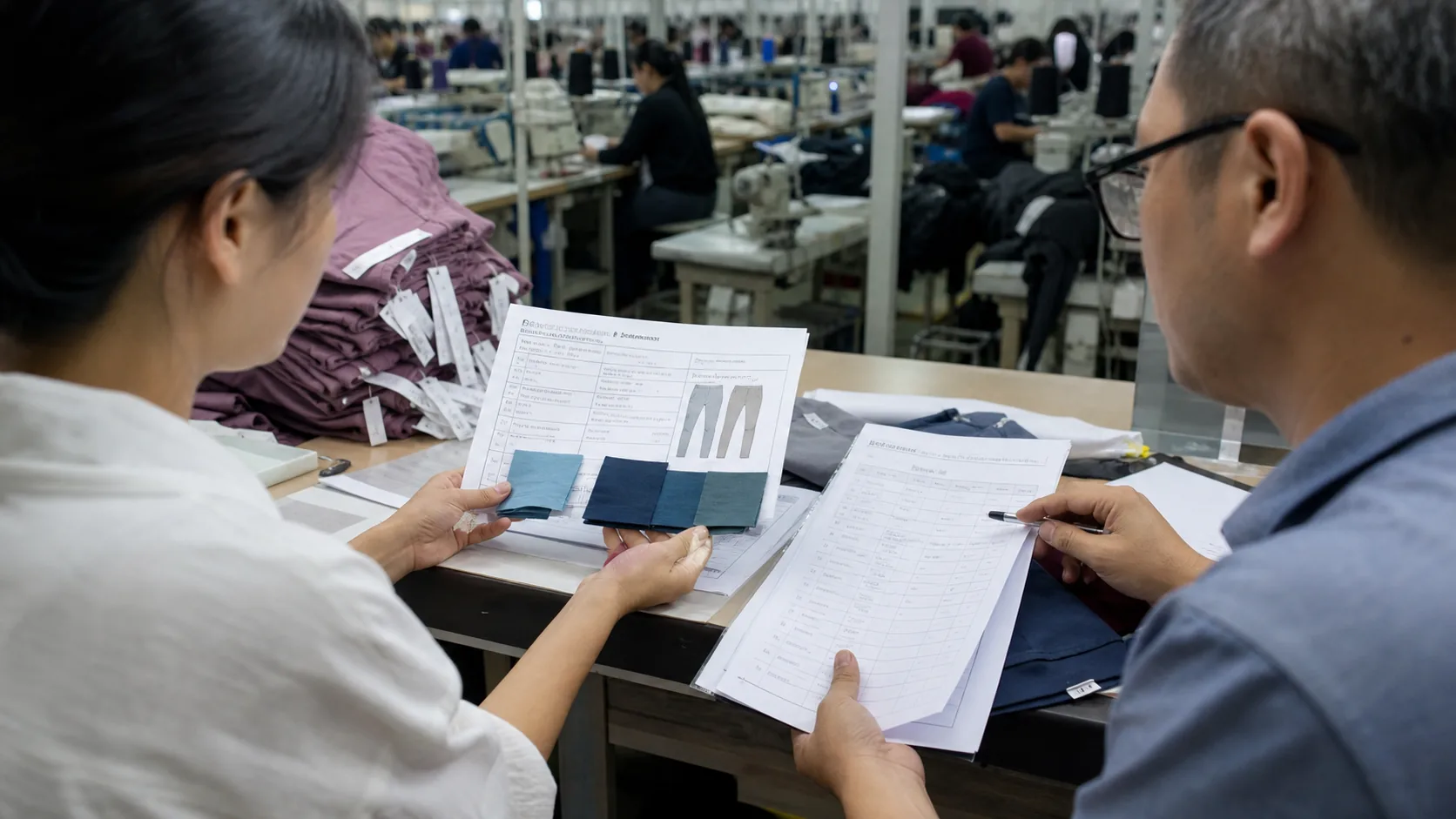
A factory or supplier audit is a structured visit that checks a site against a defined scope, so name the scope first: it decides what the report can prove. A social-compliance audit reviews labor practices, health and safety and related management against a code. For example, amfori says its BSCI code of conduct is based on internationally recognized standards including ILO conventions, and that amfori BSCI is not a certification. A quality or technical audit asks whether the site can make your product consistently; Intertek, for instance, describes textile audits that assess the quality, procedures and systems of factories and mills.
Most audits follow the same sequence: agree the scope, standard and whether the visit is announced; send a document request; hold an opening meeting; walk the site; review records and, for social audits, interview workers; share findings at a closing meeting; then issue a report with a corrective action plan and due dates. For a quality audit of an activewear supplier, ask the auditor to follow one representative style from material receipt to packing rather than touring the showroom. Lot inspection is a separate tool, covered in the AQL inspection plan.
| Audit or check | Question it answers | What it cannot prove |
|---|---|---|
| Social compliance | How the site manages labor, health and safety and ethics against a code | That the garments meet your specification |
| Quality or technical | Whether processes, equipment and controls can make the product consistently | That a particular lot passed |
| Environmental | How the site manages chemicals, waste, water and energy | Test results for your finished garment |
| Lot inspection | Whether one lot matches the order | Anything about the site’s systems or future lots |
What should a supplier audit form or report include?
The format—spreadsheet, document or audit app—matters less than fixed fields that let two auditors reach the same conclusion. Build the form before the visit and share the scope with the supplier in advance.
- Identity: legal entity, registration number, audited address, date, auditor, audit type and whether the visit was announced.
- Scope: products, processes and buildings covered, plus anything excluded or subcontracted.
- Process sections: material receiving, cutting or knitting, sewing, printing or bonding, finishing, inline and final checks, packing and storage.
- Controls: measurement tools and calibration, approved-sample storage, revision control, defect records and corrective actions.
- Evidence: the document, photo or observation behind each finding, with a reference number.
- Findings and sign-off: each nonconformity graded by severity with an owner and due date, signed by the auditor and a site representative.
Define the scoring rule before the audit. A percentage score can hide a single critical failure unless the form says one critical finding overrides the total. Keep “not observed” separate from “not compliant”: an area the auditor could not see is a gap, not a pass. File the completed report in the claims ledger described above, so any public statement about the supplier points to a dated record with a named scope. If a supplier offers an existing scheme report instead, check that it names the same address and covers your processes; the subcontracting disclosure guide helps map work done elsewhere.
More buyer questions
What is a supplier quality audit?
It assesses whether a supplier’s systems can deliver your quality requirements consistently: specification control, material checks, process controls, measurement, inspection, handling of nonconformities and corrective action. It examines how the factory works rather than one lot of goods, so pair it with a controlled sample program and lot inspection before relying on it for an order.
Why are supplier audits important, and when is one required?
They expose risks that samples and emails cannot, such as an undisclosed subcontractor, missing controls or unsafe conditions. An audit becomes required when a retailer, brand code of conduct, customer contract or regulation says so, and buyers often choose one before a first large order or after a serious failure. It is a snapshot, so schedule follow-up on corrective actions.
Should I audit a factory in China myself or hire an auditor?
Hire an independent auditor when you need a recognized scheme, local-language interviews or a report other customers will accept; audit yourself when the goal is technical qualification of your own product. A combination often works: a scheme audit for social compliance plus your own process walk-through for quality. Either way, send the scope and checklist before the visit.
Is a supplier audit the same as a factory inspection?
No. An audit evaluates a facility’s systems and practices; an inspection checks whether a specific lot of goods matches the order. A strong audit does not show that your shipment is right, and a passed inspection does not show that the factory’s processes are controlled. Use each for the decision it was designed to support.
Can I use another buyer’s audit report instead of commissioning one?
Sometimes. amfori, for example, describes a shared pool of audit data in which one report benefits several members, and says only its members and the audited suppliers can access the full reports. Ask the supplier for access or a copy, then check the audited address, date, scope and open corrective actions against your own order before relying on it.
