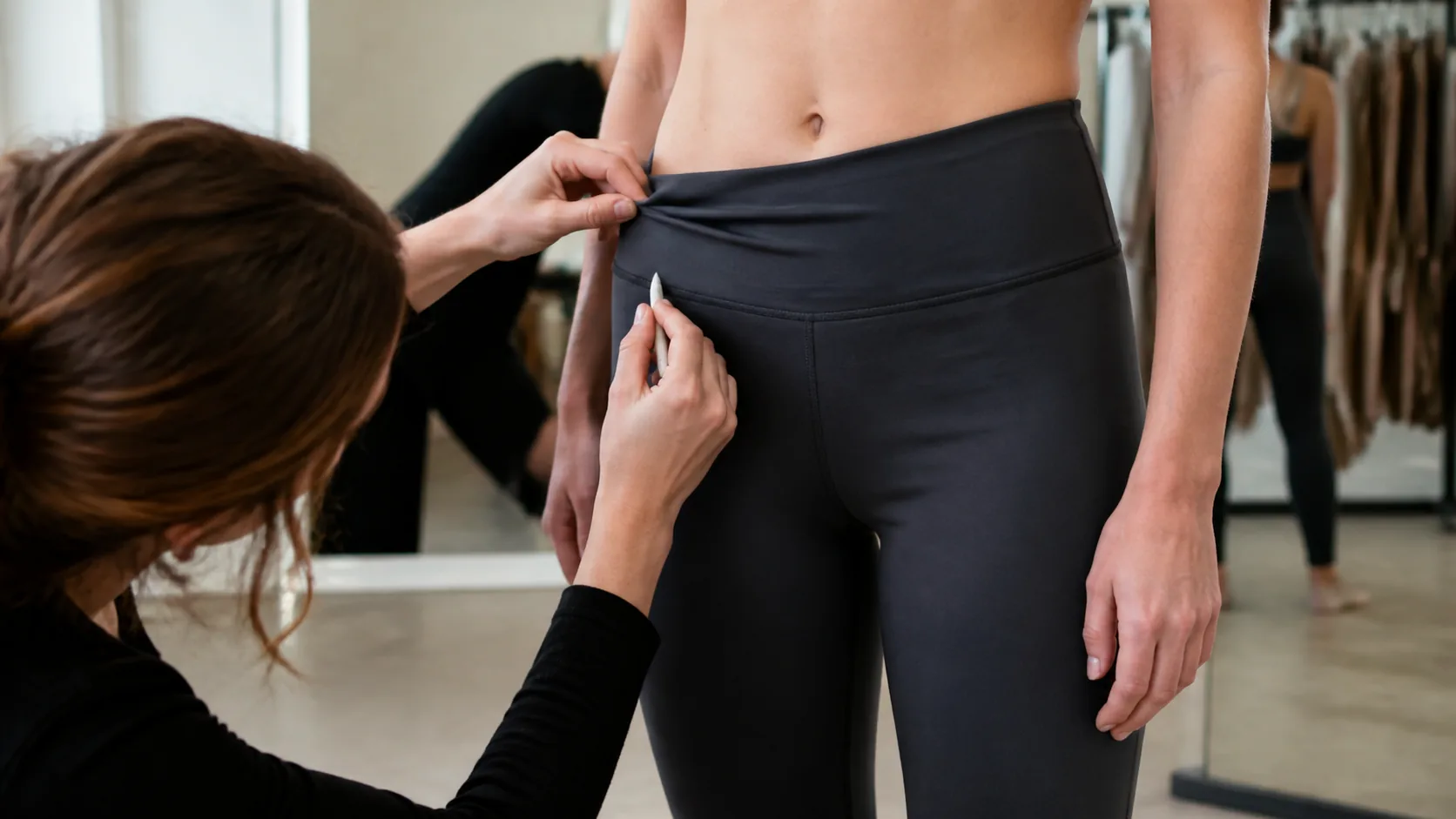
The short answer
Yoga legging waistbands commonly roll because the band shape does not follow the body, the top edge carries the wrong tension, the rise places the fold line at a high-movement zone, the fabric lacks recovery, or seam bulk creates a hinge. Tightening the band without identifying the cause can add pressure while leaving the roll.
Observe when and where the roll starts.
Compare body shape with the band pattern shape.
Test recovery and seam construction with the actual fabric.
Document the behavior before altering the pattern
Record whether the top edge folds outward, the entire band slides down, the center front collapses or one side rolls first. Note the movement and time required to trigger it. A roll during a seated fold points to a different interaction than gradual sliding during walking.
Check pattern shape and rise
A straight band asked to follow a curved torso can gape or fold. A contoured band can distribute tension more evenly, but only if its shape matches the target block. Rise and waistband height also determine where the top edge meets the body during flexion.
Check recovery and internal support
Compare the body and waistband materials after repeated extension. If internal elastic or support is used, identify its width, modulus, application tension and join. The strongest elastic is not automatically the most comfortable or stable choice.
Look for a construction hinge
Multiple seam allowances, pockets or heavy topstitching can create a stiff line beside a soft panel. Review cross-sections, seam direction and bulk at center front, side and back. Then repeat the movement protocol after washing because recovery and seam settling can change.
Decision map from this guide
| Decision area | What this guide establishes |
|---|---|
| Document the behavior before altering the pattern | Record whether the top edge folds outward, the entire band slides down, the center front collapses or one side rolls first. |
| Check pattern shape and rise | A straight band asked to follow a curved torso can gape or fold. |
| Check recovery and internal support | Compare the body and waistband materials after repeated extension. |
| Look for a construction hinge | Multiple seam allowances, pockets or heavy topstitching can create a stiff line beside a soft panel. |
Sources and scope
This guide translates primary standards and public technical sources into a buyer-side development workflow. It does not replace legal advice, a purchased standard, laboratory instructions or project-specific engineering.
Buyer questions
Will adding elastic always stop roll-down?
No. Elastic can help when the design calls for it, but it cannot correct every pattern-shape, rise or fabric-recovery problem.
Should the waistband be tested only in the sample size?
No. Review selected graded sizes because body shape and tension do not scale uniformly.
More buyer questions
Why are so many yoga pants high-waisted?
A high rise gives more coverage when the wearer bends or folds, and a taller band spreads its tension over a wider area of the torso. Many customers also prefer the look. Height alone does not keep a waistband in place, though: a tall band with the wrong shape or recovery can still fold, so review it with the same movement protocol as any other band.
