The short answer
A gusset can redistribute seam intersections, add movement room and shape the crotch area, while a front seam can support pattern shaping and assembly. Removing the front seam changes the pattern and strain map; it is not simply deleting one stitch line. Evaluate the complete pattern with the intended fabric and size range.
Treat the gusset as a pattern component, not decoration.
Review seam placement under movement and stretch.
A no-front-seam style needs its own pattern and grading validation.
Define the functional problem
Ask whether the project is solving mobility, comfort, visual line, coverage or assembly. The answer determines gusset shape, orientation and seam placement. A shape copied from another pattern may not match the new rise, fabric or body block.
Understand what the front seam contributes
The front seam can create three-dimensional shaping and a clear assembly route. Removing it shifts shaping into other seams or the fabric itself. Review center-front extension, rise, crotch shape and recovery together rather than changing the seam in isolation.
Control stretch and seam bulk
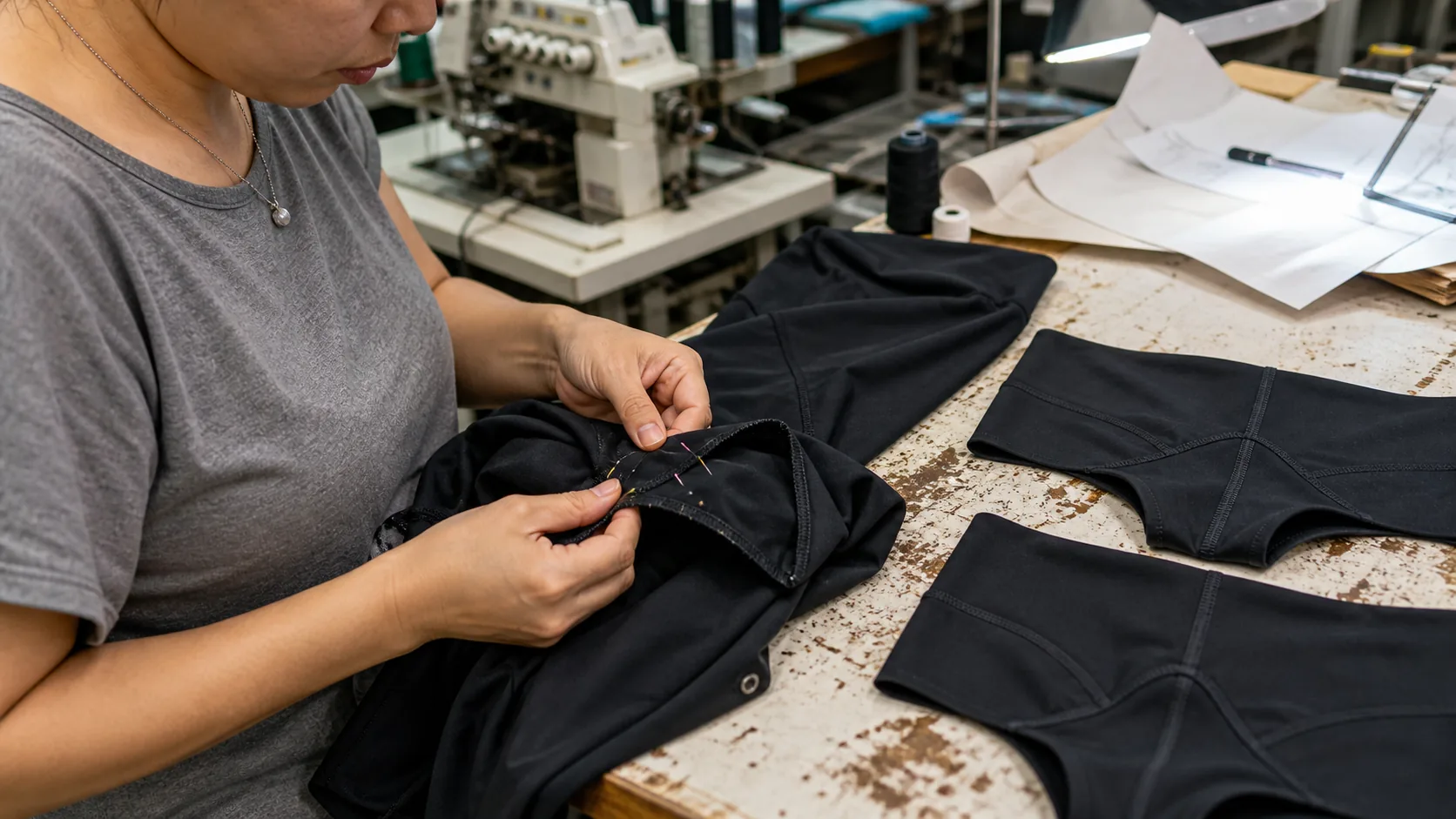
Name the seam and stitch direction, allowance, thread and reinforcement at intersections. Evaluate the seam at the actual garment strain. A flat-looking sample can still create pressure or visibility when stretched on body.
Add focused inspection points
Check symmetry, seam position, skipped stitches, puckering, reinforcement and measurement at the relevant rise and gusset points. Compare the result with the approved sample and current pattern revision.
Decision map from this guide
| Decision area | What this guide establishes |
|---|---|
| Define the functional problem | Ask whether the project is solving mobility, comfort, visual line, coverage or assembly. |
| Understand what the front seam contributes | The front seam can create three-dimensional shaping and a clear assembly route. |
| Control stretch and seam bulk | Name the seam and stitch direction, allowance, thread and reinforcement at intersections. |
| Add focused inspection points | Check symmetry, seam position, skipped stitches, puckering, reinforcement and measurement at the relevant rise and gusset points. |
Sources and scope
This guide translates primary standards and public technical sources into a buyer-side development workflow. It does not replace legal advice, a purchased standard, laboratory instructions or project-specific engineering.
Buyer questions
Does every yoga legging need a gusset?
No. The decision depends on the pattern, material, movement and construction strategy.
Is no-front-seam always more comfortable?
No. Comfort depends on pattern shape, fabric strain, seam construction and individual body interaction, not seam count alone.
More buyer questions
What is a front seam on leggings?
It is the seam running down the center front of the rise, from the waistband to the crotch, where the left and right front panels join. Pattern makers also call it the front rise seam. Its curve decides how the front rise sits on the body, and in light or shiny fabrics the seam line can be visible, one reason a design may leave it out.
What does no front seam mean on leggings?
It means the front rise is cut as one piece across the center, with no join running from waistband to crotch. It is usually chosen for a smoother front appearance. The pattern then depends on the gusset shape and on the fabric’s stretch in its new cutting direction, so check how the front sits across the lower abdomen during movement and in each graded size.
How do brands reduce visible crotch contouring, sometimes called camel toe?
Through pattern, fabric and sizing together. A front rise that is too short or curved too deeply can pull fabric into the body, and a center-front seam can emphasize the line. Typical corrections include reshaping the front rise, adding or reshaping a gusset, choosing fabric with better recovery and confirming the size chart. Review each correction on a body in movement, not only on a form.
What should a no-front-seam legging with pockets or a flare be checked for?
Check that each added feature keeps the smooth front intact. Pockets should hold their intended load without dragging the side panel toward the center; a flare needs knee and hem placement reviewed separately from the rise; a firm compressive fabric needs enough stretch across the one-piece front. A well-developed version passes these checks in several sizes, not only in the base sample.
