The short answer
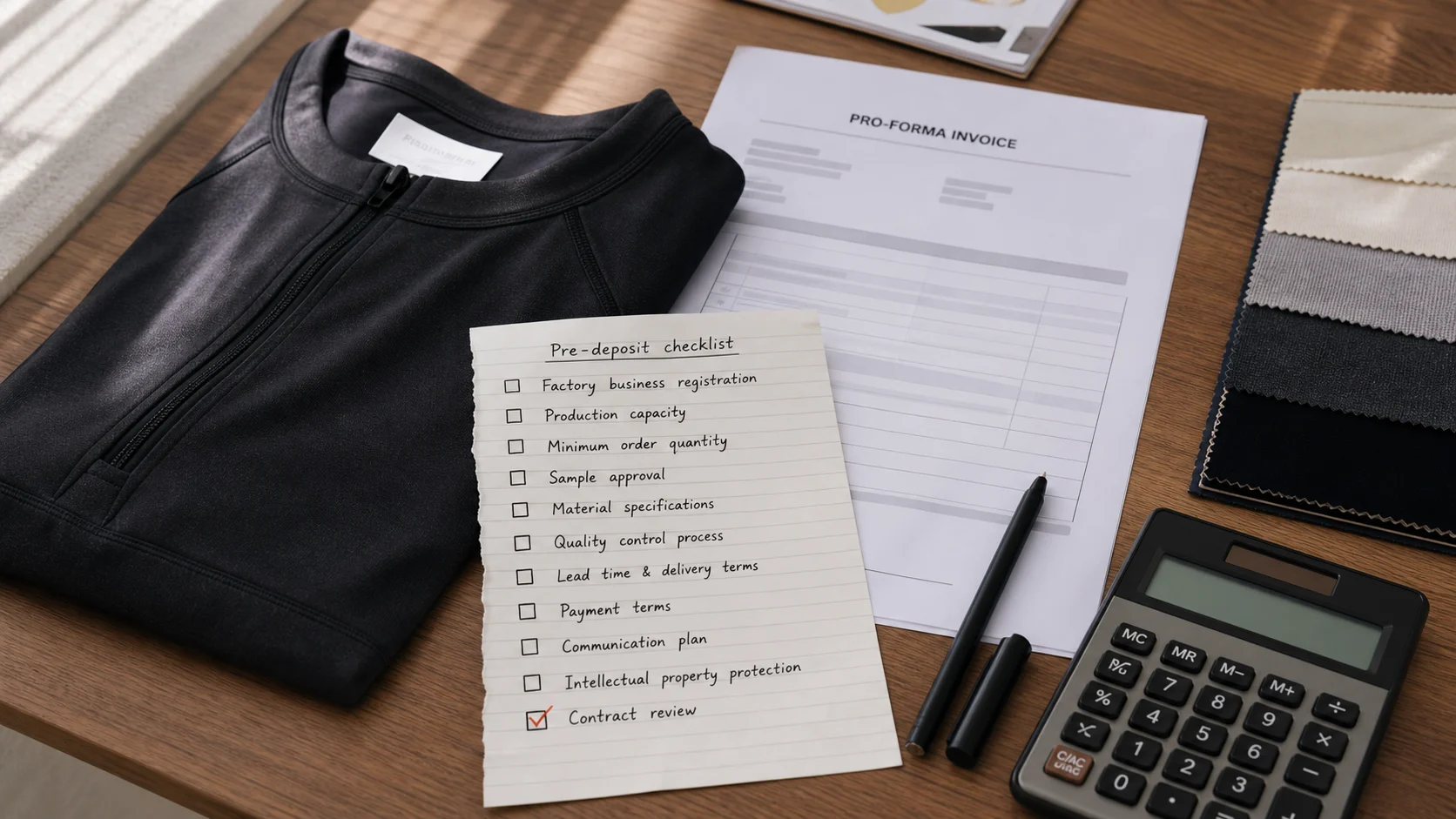
Before paying a factory deposit, verify the contracting legal entity and payment beneficiary, reconcile the final quotation and purchase order, identify the production facility and any subcontracted processes, confirm the approved product baseline, state what the deposit authorizes, record intellectual-property and confidentiality terms, define delivery and inspection responsibilities, and keep a written exception list. If an identity, account change or product-critical scope cannot be explained, pause and verify through an independent channel.
Confirm the beneficiary through a second known channel when payment instructions change.
Make the deposit trigger and authorized work explicit.
Keep product acceptance, shipment release and dispute terms in the signed record.
Verify who is asking for payment
Match the legal name and address on the quotation, invoice and contract. Confirm how the website or sales contact relates to that entity. Review the bank beneficiary and country, and ask for written support when it differs from the contracting party. If payment instructions change, verify the change through a previously known phone number or other independent channel rather than replying inside the same email chain.
This is basic transaction hygiene, not a guarantee against loss. Use legal, banking and trade professionals appropriate to the order and jurisdiction.
Reconcile the final commercial scope
Attach the current style revision, quantity matrix and quotation to the purchase order or agreement. List material, color, size, branding, label, packaging, sample stages, testing, inspection and delivery basis. Mark every allowance, exclusion and provisional line. A deposit should not convert a seller’s estimate into a fixed product definition by assumption.
Record whether the payment starts material reservation, pattern work, sampling, bulk materials or production. Those are different commitments and can carry different cancellation consequences.
Confirm what is approved—and what is not
Identify the latest sample and specification revision. If bulk is not yet authorized, write that the deposit covers development or reservation only. If a pre-production sample, lab dip, logo strike-off or size set remains open, state the hold point and name the person who can release it.
Do not use “sample approved” as one status when fit, material, color, workmanship and packaging were reviewed at different stages. The record should show the actual scope of each approval.
Connect the order to the production route
Name the expected garment facility and disclose off-site materials, dyeing, printing, embroidery, bonding or packing where relevant. Decide what change requires buyer notice and reapproval. A contract with the seller should state who remains accountable for approved subcontractors.
For certifications, review the holder, facility, product or process scope and validity. A facility certificate may qualify an operation; it does not automatically certify every material or shipment.
Write the intellectual-property and confidentiality boundary
WIPO advises businesses to clarify in writing what they contribute, what the supplier creates, who owns new work, how each party may use it, what copies must be delivered and what happens when the relationship ends. Apply that structure to artwork, patterns, grading, molds, knitting programs, technical files and confidential reference samples.
An NDA alone may not assign ownership. The appropriate clauses depend on the work and governing law, so obtain qualified advice instead of copying a generic template.
Define inspection, shipment and exception decisions
State the delivery rule and named place, who arranges transport, what documents are due and what event permits shipment. If final inspection is used, define the lot, sampling basis, defect classes, report recipient and authority to accept rework or deviation. Incoterms® allocate delivery obligations and risk; they do not define garment acceptance.
Finish with an exception schedule: every unresolved item, owner, due date and consequence if it stays open. Paying against a visible exception list is safer than treating silence as agreement.
Decision map from this guide
| Decision area | What this guide establishes |
|---|---|
| Verify who is asking for payment | Match the legal name and address on the quotation, invoice and contract. |
| Reconcile the final commercial scope | Attach the current style revision, quantity matrix and quotation to the purchase order or agreement. |
| Confirm what is approved—and what is not | Identify the latest sample and specification revision. |
| Connect the order to the production route | Name the expected garment facility and disclose off-site materials, dyeing, printing, embroidery, bonding or packing where relevant. |
| Write the intellectual-property and confidentiality boundary | WIPO advises businesses to clarify in writing what they contribute, what the supplier creates, who owns new work, how each party may use it, what copies must be delivered and what happens when the relationship ends. |
| Define inspection, shipment and exception decisions | State the delivery rule and named place, who arranges transport, what documents are due and what event permits shipment. |
Sources and scope
This guide translates primary standards and public technical sources into a buyer-side development workflow. It does not replace legal advice, a purchased standard, laboratory instructions or project-specific engineering.
Buyer questions
Should the deposit be paid before sample approval?
That depends on what the payment authorizes. If it funds development, say so. Do not let a development payment silently authorize bulk production.
Is a pro-forma invoice enough?
It may document a commercial offer, but the required contract, purchase order, product specification, IP terms and acceptance process depend on the project and jurisdiction.
What if the supplier changes bank accounts?
Pause and verify the instruction through a second, previously trusted channel. Ask for a written explanation and supporting entity information.
Does FOB mean the goods passed quality inspection?
No. Delivery terms and product acceptance are separate. Write the inspection and release conditions explicitly.
More buyer questions
What is supplier verification, and what does the process involve?
Supplier verification confirms that a supplier is who it claims to be and can do what it claims. Check the legal entity and registration, the bank beneficiary through an independent channel, the facility address and its ownership or relationship, the processes for your product and any certificates by holder and scope. Record each check with its date, source and result.
How can you tell if a supplier is an approved supplier?
Ask “approved by whom, for what and when?” Approval is a status inside one buyer’s or retailer’s system after its own evaluation, not a universal credential. If a supplier claims approval by a brand, ask for evidence the brand itself will confirm, such as its public supplier list, and remember that approval for one product or facility does not cover another.
What should a supplier verification or review form include?
Capture the facts you will rely on: legal name, registration number, registered and production addresses, ownership, business type, contacts, bank details confirmed by call-back, main products and processes, subcontractors, certificates with scope and expiry, references, and the date and person completing each check. Keep capability and price scoring on a separate evaluation form.
What is a supplier verification certificate?
Usually a report or badge from a third party saying certain facts were checked on a certain date. Alibaba.com, for example, describes Verified Supplier as a membership tier whose verification produces an assessment report from a third-party inspection company. Read the report’s scope and date; verification is not a guarantee of product quality or future performance.
How do I pay an Alibaba supplier safely?
Pay through the platform if you want its order protection. Alibaba limits Trade Assurance protection to orders paid online through Alibaba.com; check its current list of accepted payment methods before paying. Paying a supplier’s own account outside the platform gives up that protection, so apply the same beneficiary checks as for any direct payment.
What is supplier matching?
The term has two common uses. Sourcing platforms and agents use it for matching a buyer’s request to candidate suppliers, and those matches are leads to verify, not approvals. In accounts payable, matching means comparing the purchase order, goods receipt and invoice before paying, which is a useful control before releasing a balance payment after a deposit.
