The short answer
On a factory video call, begin with the legal and contracting identity, then follow the proposed product from material receipt through the sample room, pattern or seamless programming, cutting or knitting, sewing, finishing, inspection and packing. Ask the guide to show a current, non-sensitive work record connected to each stage. Record what was visible, what was not shown and what still requires document review or an independent audit. A live tour is a screening tool, not certification.
Verify the facility and the proposed process, not the presenter’s sales claims.
Use real-time requests that are difficult to satisfy with a prerecorded showroom tour.
Close the call with a written gap list and evidence owner.
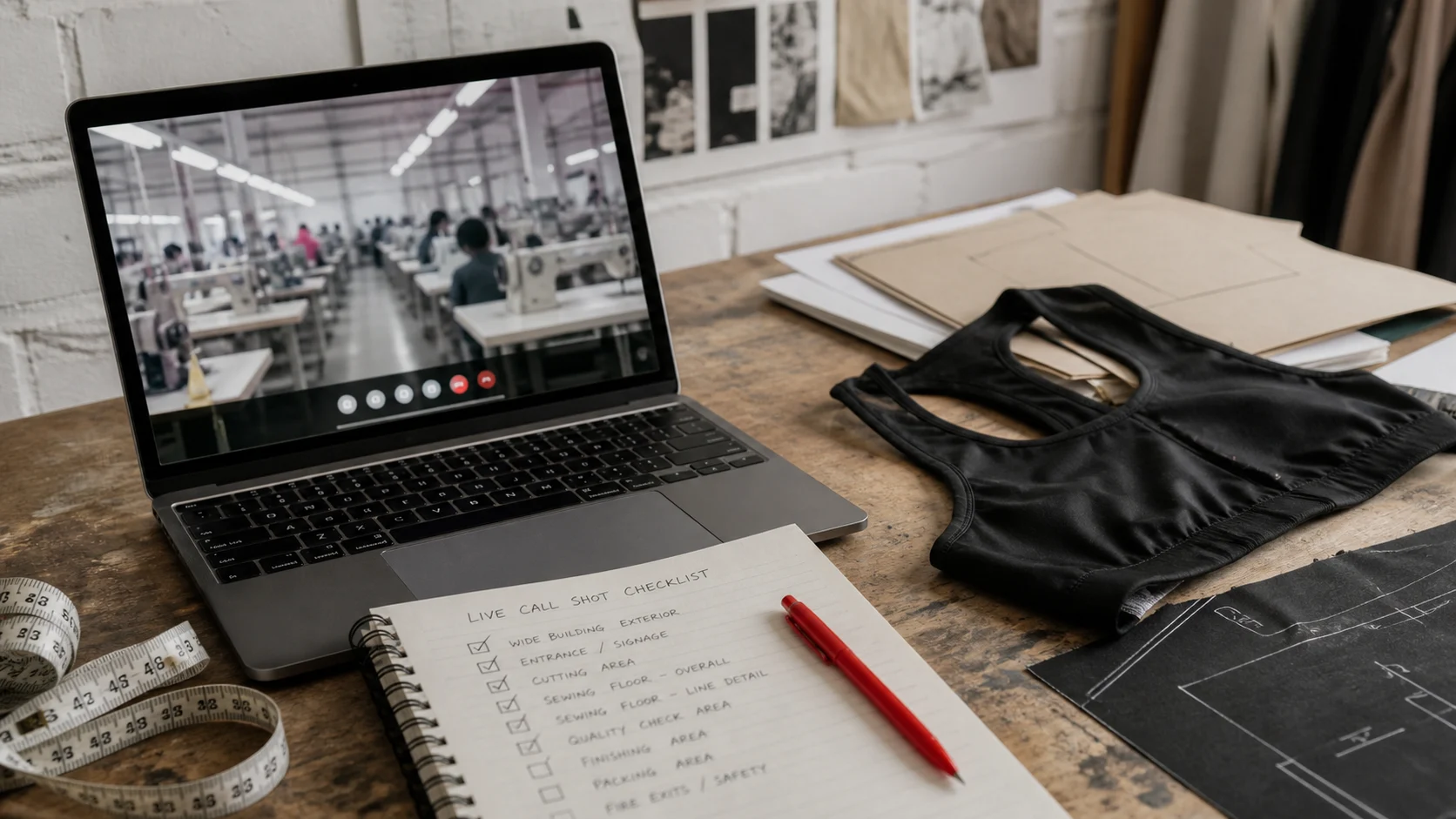
Send the shot list before the call
State the style or product family you are qualifying, its construction route and the processes you need to understand. Ask whether any process is performed at another site. A prepared supplier can arrange safe access without exposing another buyer’s confidential work; a buyer should not demand brand labels, order sheets or faces that the facility is not permitted to show.
Request the facility address and legal business name in advance, then compare them with the quotation, invoice and registration material supplied for due diligence. If the contracting seller and production facility are different entities, ask for the relationship and responsibility to be stated instead of assuming one is a disguised version of the other.
Establish that the call is live and location-specific
At the start, ask the guide to show a neutral location marker that does not reveal sensitive data: the exterior or reception name where permitted, the current date on a blank board, and a continuous transition from entry to the relevant working area. Ask an unscripted question or request a view of a safe nearby object. These steps reduce the chance that a promotional montage is mistaken for a live facility review.
They do not prove ownership, legal status or that your order will run there. Those questions require documents, contractual disclosure and later order-specific evidence.
Follow the actual route proposed for your garment
A cut-and-sew legging and a seamless knitted set do not use the same equipment or workflow. Ask the supplier to explain where the body material is received and checked, where development samples are made, how patterns or knitting programs are controlled, where panels are cut or garments knitted, how seams and branding are applied, and where finished goods are inspected and packed.
If a stage is off-site, record the named role—mill, dye house, printer, embroidery unit or packing contractor—and ask how the approved standard and revision reach that party. “Partner factory” is a relationship label, not a control method.
Ask for records that match what you just saw
Useful examples include a blank or redacted incoming-material record, a style revision header, a sample identification tag, an inline check form and a finished-lot inspection template. The objective is to see whether the workflow leaves a trace, not to collect another brand’s data.
For a certificate or audit, note the holder, facility, scope and validity date and verify it through the issuing scheme or certification body where possible. A logo in the office or a PDF shared during the call does not establish current order coverage.
Read the questions and handoffs, not the décor
Clean floors and modern machines are visible but incomplete signals. Listen for who receives sample comments, how superseded revisions are removed, how fabric or trim substitutions are proposed, what happens when an inline result fails and who can stop shipment. Ask the guide to describe one ordinary exception without naming a customer.
A supplier that clearly marks an off-site process or unavailable record may be more usable than one that answers every question with an unqualified yes. The objective is accountable scope, not a perfect performance.
Turn the tour into a verification log
After the call, issue a short log with three states: observed live, supported by a follow-up document, and not verified. Add the facility, date, participants, proposed product route and outstanding evidence. Ask the supplier to correct factual errors.
Escalate higher-risk or higher-value projects to an independent audit, sample program and order-specific inspection plan. Do not let a video call replace the controls that only exist once the actual style, material and production lot are known.
Decision map from this guide
| Decision area | What this guide establishes |
|---|---|
| Send the shot list before the call | State the style or product family you are qualifying, its construction route and the processes you need to understand. |
| Establish that the call is live and location-specific | At the start, ask the guide to show a neutral location marker that does not reveal sensitive data: the exterior or reception name where permitted, the current date on a blank board, and a continuous transition from entry to the relevant working area. |
| Follow the actual route proposed for your garment | A cut-and-sew legging and a seamless knitted set do not use the same equipment or workflow. |
| Ask for records that match what you just saw | Useful examples include a blank or redacted incoming-material record, a style revision header, a sample identification tag, an inline check form and a finished-lot inspection template. |
| Read the questions and handoffs, not the décor | Clean floors and modern machines are visible but incomplete signals. |
| Turn the tour into a verification log | After the call, issue a short log with three states: observed live, supported by a follow-up document, and not verified. |
Sources and scope
This guide translates primary standards and public technical sources into a buyer-side development workflow. It does not replace legal advice, a purchased standard, laboratory instructions or project-specific engineering.
Buyer questions
Does a factory video call prove the supplier owns the facility?
No. It can show access and a live location. Ownership or contractual control needs separate legal and documentary evidence.
What if the factory will not show other customers’ orders?
That can be a legitimate confidentiality boundary. Ask for redacted process records and a demonstration using your own sample or neutral material.
Should every process be in one building?
Not necessarily. Specialist mills, dye houses, printers and other processors may be separate. The important issue is disclosure, qualification and control of the approved standard.
Can the call replace an independent audit?
No. Use it for screening and scoping. Decide whether an audit is needed from project value, product risk, market requirements and the evidence gaps that remain.
More buyer questions
Is it worth visiting a factory in China in person instead of a video call?
For a first large order or a complex product, an in-person visit usually shows more: material stores, line balance, working conditions and how staff handle unplanned questions. A video call is cheaper for early screening. Plan any visit around one representative style, bring the checklist from this guide and avoid dates when the factory is closed or short-staffed.
How do I arrange a factory tour in China?
Ask for the legal name and full address of the facility that will make your style, confirm who will host you and which processes you will see, and request the actual production route rather than a showroom. If a trading company organizes the visit, ask how it is related to the factory. Check current entry requirements through official government sources before traveling.
