The short answer
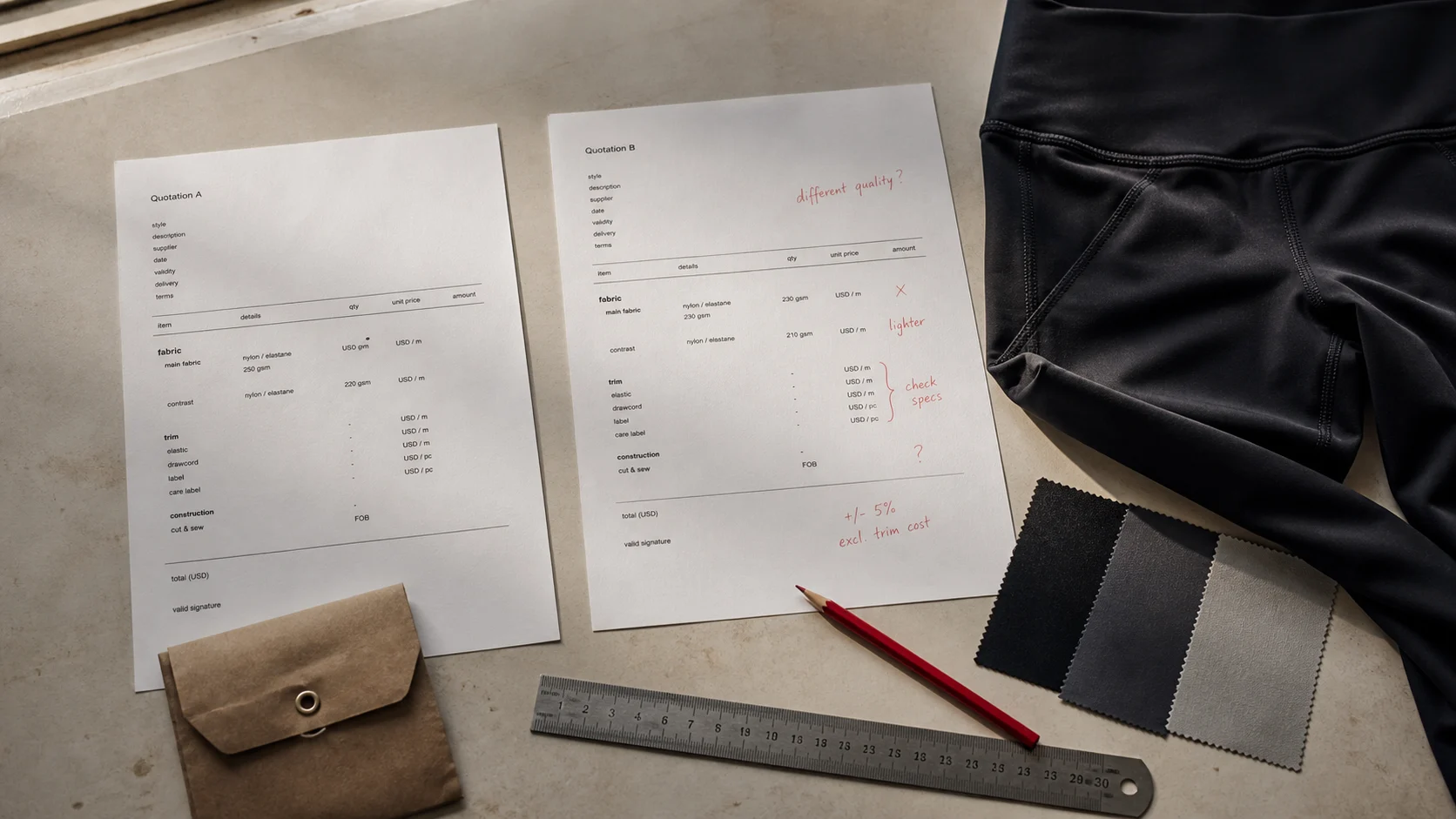
Do not compare the headline unit prices until every supplier has priced the same style revision, material identity, color and size breakdown, branding, packaging, sample path, testing and inspection scope, delivery rule and named place. Build a normalization sheet that marks each line as included, excluded, provisional or not stated. The best comparison is the total responsibility you can verify—not the smallest number in the price column.
Send one controlled brief and quantity matrix to every shortlisted supplier.
Separate product cost, one-time development cost and delivery responsibility.
Treat every blank or “standard” line as an open question until defined.
Why buyers keep receiving quotes they cannot compare
Founder discussions repeatedly describe the same frustration: several suppliers answer the same inquiry with different minimum units, fabric descriptions, sample fees and delivery terms. The apparent price range often reflects different interpretations of the product rather than different prices for the same product. One supplier may assume a stocked fabric and standard label; another may include custom color, grading and packaging; a third may leave those lines for later.
The remedy is not a longer opening message to fifty factories. It is a short qualification message followed by one controlled request for quotation after the supplier confirms category fit. The request should identify the garment, target quantity by color, destination, intended use and the current specification revision. It should also ask the supplier to flag anything it cannot price without a sample or material decision.
Freeze the product and quantity basis first
Give every supplier the same style code and revision. Include drawings or clear reference views, points of measure, size range, construction, body and lining materials, trims, logo method, label set, packaging and required approvals. Where an item is open, request the same alternatives from each supplier—for example, one route using a stocked fabric and one using a custom color.
Show quantities as a matrix, not a single total. A stated minimum can attach to a style, color, size, fabric lot, trim order or production route. Ask the supplier to state the unit to which its minimum applies and whether sizes may be mixed. Do not turn a supplier-specific answer into a universal market rule.
Separate recurring, one-time and conditional costs
Place the garment unit price apart from pattern work, grading, sample development, artwork setup, molds or screens, testing, inspection, special packing and courier. Record which charges can be credited later only if the written quotation says so. A conditional credit is not the same as a free service.
For every cost, add an owner and trigger. Who orders the lab test? At which sample or bulk stage? Who pays for a failed resubmission? Who provides barcode data? Who approves a replacement trim? These questions expose scope differences that a single unit price hides.
Name the delivery rule and the place
An Incoterms® rule allocates delivery obligations, costs and risk between seller and buyer, but the rule must be paired with a named place. “FOB price” without the port, cargo readiness assumptions and included export handling is incomplete. Likewise, a delivered quote should state which destination duties, taxes, brokerage, accessorial charges or remote-area costs are included or excluded.
Keep the sales contract, transport contract, payment terms and product acceptance plan separate. An Incoterms® rule does not define garment quality, transfer intellectual property or decide whether a shipment passes inspection.
Price the control plan, not the phrase “quality included”
Ask what sample represents the production baseline, how revisions are issued, which material and color references are retained, what inline checks are recorded and what final inspection scope is quoted. If independent inspection is required, identify who appoints the inspector, where access is provided and how a failed result affects shipment release.
A supplier can be commercially attractive while leaving part of the evidence open. Mark that gap as “not stated” and price the work needed to close it. Do not reward a vague answer by treating it as included.
Use a three-column decision: price, responsibility, uncertainty
First compare the normalized commercial total. Second compare which party owns each development and production decision. Third compare unresolved assumptions and the evidence required before deposit or bulk release. A higher quote may still be the lower-risk route when it includes work another supplier expects the buyer to coordinate; a lower quote may be valid when the buyer already owns that work.
Send the completed normalization sheet back to each supplier for confirmation. The winning quote should survive that written reconciliation without changing the product basis.
A headline quote and a normalized quote answer different questions
| Decision dimension | Headline quote | Normalized comparison |
|---|---|---|
| Product basis | A style name, photo or short description. | The same style code, revision, BOM, colorways, sizes and quantity split. |
| Material | Generic composition or fabric name. | Supplier or mill reference, construction, weight direction, finish, color route and approved substitute rule. |
| Development | Sample fee shown without scope. | Pattern, grading, sample stages, included revisions, courier and ownership stated separately. |
| Delivery | FOB, EXW or DDP written without a precise place or scope. | Named place, Incoterms® 2020 rule and excluded destination costs recorded. |
| Decision | Choose the lowest unit price. | Compare landed responsibility, open assumptions and the cost of closing evidence gaps. |
Decision map from this guide
| Decision area | What this guide establishes |
|---|---|
| Why buyers keep receiving quotes they cannot compare | Founder discussions repeatedly describe the same frustration: several suppliers answer the same inquiry with different minimum units, fabric descriptions, sample fees and delivery terms. |
| Freeze the product and quantity basis first | Give every supplier the same style code and revision. |
| Separate recurring, one-time and conditional costs | Place the garment unit price apart from pattern work, grading, sample development, artwork setup, molds or screens, testing, inspection, special packing and courier. |
| Name the delivery rule and the place | An Incoterms® rule allocates delivery obligations, costs and risk between seller and buyer, but the rule must be paired with a named place. |
| Price the control plan, not the phrase “quality included” | Ask what sample represents the production baseline, how revisions are issued, which material and color references are retained, what inline checks are recorded and what final inspection scope is quoted. |
| Use a three-column decision: price, responsibility, uncertainty | First compare the normalized commercial total. |
Sources and scope
This guide translates primary standards and public technical sources into a buyer-side development workflow. It does not replace legal advice, a purchased standard, laboratory instructions or project-specific engineering.
Buyer questions
Should I tell factories my target price?
A target can help a supplier propose a viable route, but pair it with the intended product, market and non-negotiable requirements. A price without scope encourages assumption rather than engineering.
Is the lowest unit price automatically the cheapest option?
No. Compare one-time charges, excluded components, testing, inspection, transport responsibility and the cost of resolving open assumptions.
What does “MOQ” need to specify?
Ask whether it applies per style, color, size, fabric, trim, order or production route, and whether sizes or colors may be mixed.
Can Incoterms® define who owns the pattern?
No. Product acceptance, payment and intellectual-property ownership need their own written terms.
More buyer questions
How much do clothing samples cost?
There is no reliable sample price without a defined scope. Ask for a written breakdown covering pattern work, materials, construction, revisions, grading and shipping, with each item marked included or separate. Compare the same garment and sample stage across suppliers. Keep development charges apart from the eventual production unit price; one does not establish the other.
Are clothing samples free or refundable?
Treat a sample as chargeable unless the supplier confirms different terms in writing. If a fee can be credited against production, record the qualifying order, deadline, amount covered and exclusions. A conditional credit is not an upfront free sample. Ask what happens if you reject the sample, change the design or do not place a production order.
How do I break down the landed cost of women’s workout clothes?
List every cost from factory to warehouse per unit: product price and packaging, development charges spread over the order, testing and inspection, export handling, freight and insurance, customs duty and import taxes, brokerage and final delivery. Allocate shared costs by a stated rule, such as units or value, and keep one-time charges separate so reorders are priced fairly.
Can import duty be capitalized into inventory cost?
Under IFRS, generally yes when the duty cannot be recovered. IAS 2 says the costs of purchase of inventories include import duties and other taxes other than those later recoverable from the tax authorities, plus directly attributable transport and handling. Taxes you can reclaim, such as recoverable import VAT, stay out. Confirm the treatment with your accountant, especially under another reporting framework.
Which official tools show import duty for the USA, UK, Canada or Australia?
Start with each government’s tariff. The UK’s Trade Tariff service lets importers find a commodity code and check whether duty or VAT is due, and U.S. rates sit in the Harmonized Tariff Schedule administered by the U.S. International Trade Commission. For Canada and Australia, use the customs authority’s published tariff. A private calculator is only as good as the classification, origin and value entered.
How much import tax will I pay on a clothing shipment?
You cannot know until four facts are fixed: each garment’s tariff classification, its country of origin, the customs value the destination uses, and any additional duties, import VAT or GST and fees. Similar-looking garments can fall under different codes, so confirm classification with a licensed customs broker or a binding ruling before pricing; in the U.S., the CROSS database holds such rulings.
Additional sources
- CBI: substantiated quotations and buyer communication
- IFRS Foundation: IAS 2 Inventories (reviewed 27 September 2026)
- GOV.UK: Trade Tariff—look up commodity codes, duty and VAT rates (reviewed 27 September 2026)
- International Trade Administration: Harmonized System (HS) codes (reviewed 27 September 2026)
Read the Spanish guide to choosing a sportswear manufacturer.
Further buyer answers
Why can clothing samples cost more per piece than bulk production?
A sample quotation may include one-off pattern, sourcing, setup and revision work spread over very few garments. Ask which charges apply to your assignment rather than assuming every sample carries the same premium. Separate reusable development work from making the physical item, and confirm credit conditions in writing. A high sample fee alone does not prove better quality.
How can I negotiate a factory quote without losing the specification?
Ask the supplier to price clearly identified alternatives while keeping one unchanged reference quote. Compare changes in materials, colours, decoration, quantities and delivery responsibilities separately. Record which requirements each saving would alter and reject unapproved substitutions. Confirm the revised scope and exclusions in writing; a lower total is not a saving if it describes a different product or leaves essential work unpriced.
